

The first time it happens, you stop walking.
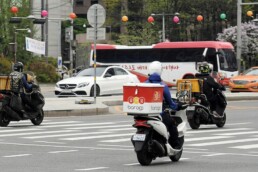
You are on Teheran-ro, the wide commercial spine of Seoul’s Gangnam district. Suddenly, a knee-high machine with round headlight eyes rolls up beside you. It pauses at the crosswalk. Then it waits for the green signal and trundles across the intersection alongside the office workers. Nobody else looks twice. For them, the scene is ordinary. For a visitor, however, it is the moment Korea delivery robots 2026 stop being a headline and start being a sidewalk neighbor.
Most foreigners arrive in Korea expecting a particular set of images. They picture neon-soaked street food alleys, palace rooftops, and the choreographed chaos of a subway transfer. However, the country has quietly built something almost no other nation has. It is a legal and physical environment where autonomous robots share the pavement with people as a matter of routine. The serving bots that bring banchan to your table get all the tourist photos, and Seoulz has already mapped that world in its coverage of Korea’s restaurant robots. The far bigger story for 2026, though, is unfolding outside the restaurant. It plays out on the open street and inside the elevator.
In essence, this is the story of how Korea taught its machines to walk among us. Moreover, it explains why the economics made it inevitable, and where the smart money is now moving.
The Law That Turned Robots Into Pedestrians
To understand Korean sidewalk robots, you first have to understand one piece of legislation. It sounds dry, yet it changed everything. In November 2023, Korea amended its Intelligent Robots Development and Distribution Promotion Act, along with the Road Traffic Act. As a result, autonomous robots that meet safety standards were granted, in effect, the legal status of pedestrians.
That phrasing is not a metaphor. Previously, delivery robots were classified as vehicles. That barred them from sidewalks entirely. It also forced engineers to build machines fast enough to mix with cars, which was an absurd and dangerous requirement. The revision flipped the logic. Now, a qualifying robot may legally travel on the pavement, so long as it obeys the same traffic rules a person does.
The criteria are specific, and they reveal how seriously regulators took the task. A certified machine must weigh 500 kilograms or less. In addition, it must measure no wider than 80 centimeters and travel at 15 kilometers per hour or slower. Furthermore, a designated certification body evaluates each model before it earns the right to roll. The review covers speed control, remote-operation capability, and the ability to recognize traffic signals. For context on how this fits Korea’s wider machine economy, Seoulz has examined the country’s world-leading robot density in a separate deep dive.
International observers noticed the shift. One technology outlet framed it as Korea granting robots a status equivalent to human pedestrians. In short, it was a milestone in the country’s smart-city ambitions. Meanwhile, academic researchers have started treating Seoul as a living laboratory. A 2026 paper presented at the ACM/IEEE Human-Robot Interaction conference studied two Seoul field sites where delivery robots navigate busy intersections alongside commuters. In particular, it probed what it means when a machine performs labor in public space. The robot pedestrian law, therefore, did not just enable a business. Instead, it opened a genuinely new social question.
The Last-Mile Race on Korean Sidewalks
With the legal door open, a scramble began. The prize is the “last mile.” This is the final, expensive, stubbornly human leg of any delivery, running from the local hub to your actual door. For decades, that leg resisted automation. Now, however, autonomous delivery robots are attacking it directly.
The clearest pure-play contender is Neubility, a Seoul startup whose squat, camera-studded robot is named Neubie. Rather than relying on expensive LiDAR alone, Neubility leaned into low-cost camera-based navigation. The bet was simple: make each unit cheap enough to deploy in fleets. Since 2024, the company has run Neubie robots in partnership with the city of Seongnam. As a result, its machines have become a familiar sight on sidewalks near Gangnam’s Teheran-ro corridor. For investors tracking the ecosystem, Neubility represents the specialist tier. In other words, it is a focused startup rather than a conglomerate side project.
The platform giants have moved too. Woowa Brothers, the company behind Baemin, Korea’s dominant food-delivery app, entered the robot-delivery arena with its own pilot fleets. Its logic was straightforward: the firm that owns the orders should also own the wheels that fulfill them. Convenience-store operators followed a parallel path. The operator of Korea’s 7-Eleven network, for instance, has tested delivery robots inside apartment complexes. There, a controlled environment and short routes make the unit economics far easier to prove. Seoulz has traced the broader staffless-retail wave in its report on Korea’s unmanned store boom, and robot delivery is the logistics layer that ties that ecosystem together.
Meanwhile, the market math explains the rush. Researchers at MarketsandMarkets projected the global delivery-robot market would expand sharply. It was set to grow from roughly $210 million in 2021 to about $960 million in 2026. Furthermore, Korea’s government has set an explicit goal to commercialize robotic delivery by 2026, with drone delivery targeted for 2027. Therefore, the sidewalk is not a novelty stage. Rather, it is a contested commercial battlefield with national policy behind it.
When the Delivery Bot Also Walks the Beat
Meanwhile, delivery is the obvious use case, yet the same wheeled platform turns out to be remarkably flexible. Once a robot can navigate a sidewalk, recognize obstacles, and stream video to a control center, it can do far more than carry a burrito. In Korea, the most interesting second act is security.
Neubility offers a vivid example. The company partnered with telecom giant SK Telecom and the security firm SK Shieldus to co-develop AI-powered patrol robots. In one early trial, the machines patrolled the campus of a women’s university in Seoul, watching for hazards and feeding footage to a central monitoring hub. In short, the pitch is straightforward. A patrol robot does not get tired, does not skip a round, and costs less than a roster of overnight guards. For a country short on young workers, that calculus is familiar by now.
Furthermore, the robots have also found a curious home on the golf course. Korea’s country-club boom created thousands of sprawling venues where staff must ferry drinks and snacks across vast greens. Neubility therefore deployed fleets at private golf clubs to handle exactly that task, while Samsung’s catering arm, Samsung Welstory, joined a similar effort. In addition, resorts, libraries, and camping sites have all tested the same hardware. Each setting shares a common trait: predictable routes, a contained area, and a chronic shortage of staff willing to walk them. As a result, the delivery robot quietly became a general-purpose service robot, and the line between “delivery” and “everything else” began to blur.
Inside the Robot-Friendly Building
If the sidewalk is the outdoor frontier, the office tower is the indoor one. Here, Korea has produced the single most striking showcase on Earth. Drive south of Seoul to Bundang, and you reach 1784, the second headquarters of Naver, the company often called the “Google of Korea.” Naver did not build a normal high-rise. Instead, it built what it calls the world’s first robot-friendly building.
Inside 1784, a fleet of around 110 autonomous robots named Rookie ferries parcels, coffee, and lunch across more than two dozen floors. Each Rookie stands about waist-high and resembles a tidy mobile cabinet. Critically, the robots are not individually “smart.” Rather, they connect over 5G to a cloud platform called ARC, the AI, Robot, Cloud system. That platform acts as a shared brain, handling vision, mapping, and routing for the whole fleet at once. According to Naver Labs, offloading computation to the cloud cuts each robot’s manufacturing cost and battery drain. As a result, the building becomes the computer, and the robots become its limbs.
The design details are where it gets clever. Elevators are a notorious bottleneck for indoor robots. Therefore, Naver built a dedicated robot-only elevator system called Roboport, so a Rookie never has to wait out a lunchtime crush. Engineers also discovered an odd problem. Human passengers felt uneasy when a robot stood behind them. Consequently, they programmed the bots to occupy the front corner of a shared elevator instead. Such small touches show how much of this work is social engineering as much as it is mechanical engineering.
Naver is not alone in treating a building as a testbed. Hyundai Motor Group has deployed its DAL-e Delivery robot and a companion parking robot at Factorial Seongsu, a smart office building in Seoul. In effect, it extends the same robot-as-service logic to a different developer’s tower. Government attention has followed the hardware. In May 2026, for instance, Korea’s Minister of Land, Infrastructure and Transport toured 1784. There, the minister inspected Naver’s digital-twin technology, its ARC fleet system, the indoor Rookie, and a newer outdoor robot called Nuri, pledging policy support for commercializing mobile robots. When a transport minister spends an afternoon watching delivery bots, the sector has clearly graduated from experiment to industrial priority.
Why Korea, and Why Now
None of this happened by accident. The underlying drivers are worth stating plainly, because they explain why Korea leads while other rich nations hesitate.
The first driver is demographic. Korea’s birth rate has fallen to around 0.65 children per woman, the lowest figure ever recorded for a sovereign nation. Seoulz examined that collapse in its reporting on Korea’s birth-rate crisis. Consequently, the working-age population shrinks every year. The pool of people willing to walk packages up flights of stairs shrinks with it. The second driver is cost. Korea’s minimum wage has climbed steadily over the past decade. As a result, the human last mile grows more expensive relative to a machine that works a twelve-hour shift on a single charge. The third driver is cultural. Koreans adopted contactless, app-driven, cashless living with unusual speed. Therefore, a robot dropping a parcel at the door feels less like science fiction and more like the logical next click.
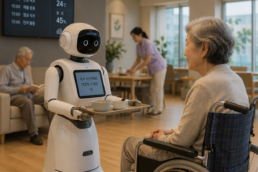
These same pressures ripple far beyond logistics. For instance, they are reshaping elder care, where machines increasingly substitute for scarce caregivers. Seoulz explored that phenomenon in depth in its piece on Korea’s care robots. In every case, a shrinking and aging society is forcing the country to rethink who, or what, does the work. Delivery is simply the most visible version of that bargain. After all, it plays out on the open street where anyone can watch.
The Conglomerate Chessboard
Behind the cheerful little robots sits a high-stakes contest among Korea’s largest companies. Each one pursues a distinct strategy. Understanding the board matters for anyone weighing where value will accrue.
Naver has bet on the cloud and the building as a system. In practice, it sells robot intelligence as a service rather than selling robots as boxes. Hyundai Motor Group, by contrast, bought its way to the frontier. It acquired Boston Dynamics in 2021 for $1.1 billion, at the time the largest robotics deal in Asian history. Now, it is folding humanoid ambitions into the same division that ships delivery and parking bots. Samsung chose vertical integration instead. It has steadily increased its stake in Rainbow Robotics, a humanoid spinout from KAIST, while standing as both a robot maker and a giant potential robot user. LG, meanwhile, took the international route. It invested in Bear Robotics and then raised its stake to a controlling position to anchor its service-robot line.
For readers who want the financial layer rather than the strategic one, the public markets have already noticed. Seoulz has covered the capital rotation in detail in its analysis of Korea robotics stocks, which traces how foreign money has flowed into listed names like Doosan and Rainbow. The relevant point for delivery is narrower. Increasingly, the conglomerates view sidewalk and building robots not as standalone products. Instead, they treat them as data-gathering deployments that feed their broader physical-AI roadmaps.
The Export Bet
However, a permissive home market is only valuable if it leads somewhere. For Korean robot makers, the endgame is export, and the early signs are promising. Neubility, for instance, has already pushed beyond Korea’s borders. For instance, the company ran pilots in the United States and, more strikingly, inside NEOM, Saudi Arabia’s vast futuristic megacity project. Within NEOM’s industrial zone of Oxagon, Neubie robots automated food-truck deliveries and completed roughly a thousand orders through a localized ordering app.
Similarly, the logic mirrors a pattern Seoulz has documented across Korean deep tech. A firm hardens its product against the world’s most demanding domestic conditions, then sells that battle-tested system into markets facing the same pressures. Japan, Europe, and North America all confront aging populations and rising labor costs. Consequently, a robot proven on the crowded sidewalks of Gangnam carries a credible story abroad. Moreover, recognition has followed, too. Neubility landed on the Forbes Asia 100 to Watch list, a signal that international investors are paying attention. The export bet is still young, yet it is no longer hypothetical.
What Investors Should Watch
For anyone tracking Korea delivery robots 2026 from abroad, three signals deserve particular attention this year.
First, watch component localization. Korea leads the world in robot deployment. Yet it still imports many critical parts, and the domestic localization rate for robotic components hovers near 40 percent. By comparison, Chinese makers have reportedly pushed past 60 percent. The government wants to close that gap. Therefore, the suppliers of sensors, reducers, and actuators may prove as investable as the robot brands themselves. Second, watch the regulatory perimeter. The robot pedestrian law unlocked sidewalks. However, questions about liability, crowded-street etiquette, and public acceptance remain unsettled. Indeed, the field studies emerging from Seoul suggest the social rules are still being written in real time. Third, watch the export play. Korean firms are using their dense, permissive home market as a proving ground before expanding abroad. Notably, the same demographic math driving adoption at home applies to Japan, Europe, and North America.
There are real risks alongside the promise. Many of the pure-play startups remain unprofitable. Moreover, valuations have run hot on listing-day enthusiasm, and labor unions have pushed back hard against automation in adjacent sectors. The Hyundai Motor union, for instance, declared that not a single unit of certain robots would enter its factories. Such friction is a useful reminder. Technology adoption faces human resistance regardless of demographic necessity.
The Sidewalk Is the Story
Stand on Teheran-ro long enough, and the robot will come back around. Having completed its drop, it rolls toward its next pickup with the same patient indifference. It is easy to read the scene as a gimmick. That reading, however, misses the point entirely.
The little machine crossing at the green light is the visible surface of something structural. Beneath it lie a decade of rising wages, the steepest demographic decline in the modern world, a cashless culture, and a government that decided, deliberately, to let robots walk among its citizens. Korea did not stumble into this future. Rather, it legislated it, funded it, and built the world’s first robot-friendly building to prove it could work. For foreign investors, operators, and curious visitors alike, the lesson is simple. The most important robot in Korea is not the one serving your dinner. Instead, it is the one quietly sharing your sidewalk.