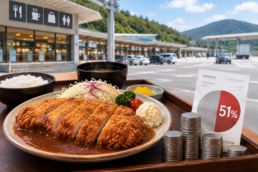


Walk into an E-Mart in Seoul on any weekday evening and you will pass two refrigerated aisles that tell the same story from opposite ends. On one side sits American chuck roll and short rib, stacked deep, priced in the mid-four-thousands per 100 grams. On the other side sits hanwoo — Korean native beef — often at two or three times that number. Each pack is wrapped like jewellery, with a QR code linking to the individual animal’s ID.
For most of the last fourteen years, a tariff stood between those two aisles. On January 1, 2026, it disappeared. The Korea beef tariff 2026 milestone was not a surprise, nor was it a negotiation. Instead, it was a scheduled countdown written into the Korea–US Free Trade Agreement back in 2012. The rate ticked down roughly 2.7 percentage points a year from a pre-FTA level of 40 percent. Nobody rang a bell. However, an entire domestic industry has been bracing for the date for over a decade.
Foreign readers usually encounter hanwoo as a menu item. It is the expensive stuff at a Korean barbecue table, ordered when the company is paying. Beneath that, though, sits one of the most stressed agricultural sectors in the developed world. Farms are closing at a rate of ten a day. Meanwhile, the herd is shrinking and feed costs never came back down. On top of that, the government has just enacted a law tying the industry’s survival to carbon neutrality. This is what that looks like from the inside.
What the Korea Beef Tariff 2026 Deadline Actually Changed
The mechanics are simple, even if the politics never were. Before KORUS took effect in March 2012, imported American beef faced a 40 percent duty. Under the agreement, that rate fell by roughly 2.7 points annually across a fifteen-year schedule. By 2024 it had dropped to about 5.3 percent. In 2025 it sat between 1.2 and 4.8 percent depending on the cut. Then, on the first day of 2026, it reached zero.
Beef did not go alone. In total, 45 categories of American agricultural and livestock products lost their tariffs on the same day — milk, cheese, fresh eggs, mandarins, walnuts, peanuts, garlic, onions. For Korean agriculture, therefore, January 1 functioned as a kind of collective deadline that had been visible on the horizon since the Lee Myung-bak administration.
The effect showed up almost immediately in the trade data. According to the US Meat Export Federation, January 2026 beef shipments to Korea reached 19,482 tonnes. That was up 4 percent year on year, with value climbing 6 percent to $192.6 million. That was the first month in which American beef entered Korea completely duty-free. Notably, Korea is already the single most valuable export market on earth for US beef.
One clarification matters here, because it is widely misreported abroad. The 2026 change was a tariff schedule reaching its endpoint, not a new concession. During the July 2025 trade negotiations, Seoul explicitly held the line on beef and rice. The Korea Times reported that both were kept off the table. Meanwhile, Korea agreed to a broader package cutting US reciprocal tariffs on Korean exports from 25 percent to 15 percent. Crucially, the 2008 ban on American beef from cattle over 30 months old also survived intact.
The Numbers Nobody in the Hanwoo Industry Wants to Read
Ask a Korean cattle farmer about tariffs and you will usually get a shrug, followed by a much longer complaint about feed. The tariff is the headline. Nevertheless, the balance sheet is the actual emergency.
As of June 2026, Korea had 72,389 hanwoo farms. That is 3,689 fewer than a year earlier — a 4.8 percent decline in twelve months, or roughly ten farms shutting down every single day. The national hanwoo herd fell to 3.15 million head, down 5.2 percent. Counting dairy-cross beef cattle as well, the total came to 3.29 million, a 4.9 percent drop.
Consolidation itself is not new. In 2000, Korea had about 314,000 cattle farms averaging 5.5 animals each. By 2024, the count had fallen to roughly 84,000 farms averaging 42.4 animals. For two decades, in other words, fewer farmers simply kept more cows, and total production held steady. Recently, though, that mechanism broke. The herd peaked at 3.70 million head in 2023 and has fallen every year since.
More worrying still is the breeding base. Fertile cows dropped from 1.64 million in June 2024 to 1.54 million by June 2026 — a loss of 100,000 breeding females in two years. Calves under one year old fell 6.7 percent. Consequently, the industry is not merely shrinking today; it is quietly disabling its ability to recover later.
The cause is not mysterious. In a Korea Rural Economic Institute survey, 79.7 percent of hanwoo farmers named production costs — feed and fuel above all — as their single largest problem. Compound feed averaged 422 won per kilogram in normal years, but hit 578 won in 2023, roughly 40 percent above 2020 levels. Prices have eased somewhat since. Even so, they have not returned to anything resembling the pre-pandemic baseline.
Why Korean Beef Costs What It Costs
Foreign visitors often assume hanwoo is expensive because of branding, and branding certainly plays a part. Underneath, though, sits a production model that is structurally costly by design.
Korean cattle are finished for an extraordinarily long time. This is a far cry from the era when a chicken cost more than beef, a period we traced in our Korean fried chicken history. In 2025, the average steer was slaughtered at 31.8 months — up 0.2 months from the previous year, because farmers extended feeding periods hoping to hit a higher grade. Average carcass weight reached 478 kilograms. By comparison, American feedlot cattle typically go to slaughter closer to 18 to 22 months. Every additional month means more imported grain, more labour, and more capital tied up in an animal that cannot be sold yet.
The reason for that long finish is the grading system. Korea grades beef on quality from 1++ down through 1+, 1, 2 and 3, with a separate yield grade of A, B or C. Marbling dominates the quality score, and marbling accumulates slowly. A 1++ carcass therefore commands a large premium, which pushes every rational farmer toward feeding longer. As the Michelin Guide has explained, 1++ hanwoo occupies roughly the position that A5 holds in the wagyu hierarchy. Even so, the fat content differs. Top-grade hanwoo carries around 28 percent intramuscular fat, versus 40 percent or more in premium wagyu.
Herd structure adds another layer of cost. Because farms average just over 40 head, Korean producers capture almost none of the scale economies available to Australian or American operations. Feed grain is imported. Land is scarce and expensive. Labour is ageing rapidly. In short, hanwoo is a boutique product being asked to compete on a commodity shelf.
The Cattle Cycle That Keeps Trapping Hanwoo Farmers
Anyone analysing the Korean beef market needs to understand its cycle, because the tariff arrived at a particularly awkward point in it.
The pattern repeats with grim reliability. When prices rise, farmers breed more. Roughly three years later — the biological lag between insemination and slaughter-ready steer — supply floods the market and prices collapse. Farmers then cull breeding stock, supply tightens, prices spike, and the cycle restarts.
Korea just lived through both halves in quick succession. Wholesale hanwoo prices averaged about 21,500 won per kilogram in early 2022. By the first half of 2023, following the breeding boom, the Korea Rural Economic Institute expected 16,500 to 17,500 won — a drop of nearly 21 percent. The Korea Herald documented the resulting squeeze as farmers absorbed record feed bills against falling revenue. Farm income for fattening operations fell from 1.43 million won per 100 kilograms in 2021 to 506,000 won in 2023, a 64 percent collapse.
Now the pendulum has swung the other way. KREI forecasts 862,000 hanwoo slaughtered in 2026, down about 8 percent, with domestic beef output falling 7.9 percent. As a result, wholesale steer prices are projected to reach roughly 20,000 won per kilogram — the strongest level in years.
Here lies the trap. Prices are recovering precisely because the production base has contracted, and precisely as duty-free American beef arrives to fill the resulting gap. Higher prices should reward surviving farmers. In practice, they may simply hand market share to imports at the exact moment domestic supply cannot respond.
Australia 2028, New Zealand 2029: Two More Cliffs Ahead
Anyone treating 2026 as the end of the story is reading the schedule wrong. The Korea beef tariff 2026 event was the first of three, not the last.
Australian beef, which competes directly with American product in Korea’s frozen and food-service segments, reaches zero duty in 2028 under the Korea–Australia FTA. New Zealand follows in 2029. Meanwhile, Australia is expected to trigger its volume safeguard partway through 2026, which temporarily raises its duty and hands the US an even larger advantage. Korean retailers, USMEF notes, have already been locking in American supply for the second half of the year in anticipation.
Import volumes tell you how much room is left to lose. In 2024, Korea imported 461,027 tonnes of beef. Of that, 221,629 tonnes came from the United States — close to half by weight, and 56.8 percent of a $3.95 billion import bill by value. The Hanwoo Association warned at the time that zero tariffs would make American beef more price-competitive still and expand that share further.
Set that against domestic output. The USDA’s Seoul post forecasts Korean beef production of 340,000 tonnes in 2026 against imports of roughly 580,000 tonnes. Put plainly, imported beef already accounts for well over half of everything Koreans eat. Hanwoo is not the default product in its own market. Rather, it is the premium exception.
Korea’s Counter-Moves After the Korean Beef Tariff Went to Zero
Seoul is not doing nothing. Whether the response is adequate is a separate question.
The centrepiece arrived on July 23, 2026, when the Hanwoo Industry Act took effect. Its full title is worth reading carefully: the Act on the Transition and Support of the Hanwoo Industry in Line with Carbon Neutrality. Few countries have ever written national legislation around a single cattle breed. Fewer still have framed such a law as climate policy.
The Act’s path was contentious. A version passed the 21st National Assembly, drew a presidential veto, and died in May 2024. The 22nd Assembly revived it with cross-party agreement, and it was promulgated in July 2025 with a one-year implementation delay. Its provisions include a five-year national plan, slaughter and shipment incentives, and farm management stabilisation measures. In addition, the Act covers distribution reform, export groundwork, and protection of hanwoo genetic material. It also creates special protection zones for rare native strains such as the black hanwoo.
Running alongside it is the low-carbon livestock certification scheme, introduced for hanwoo in 2023 and later extended to pigs and dairy cattle. The logic is unusual but coherent. A steer raised to 30 months emits roughly 5.9 tonnes of CO2 equivalent over its lifetime; cutting that to 26 months reduces emissions by about 8.92 percent. Research at Kangwon National University suggests that shortening the cycle from 30 months to 24 would cut feed costs by around 32 percent and emissions by 25 percent.
Notice what that policy is really doing. Shorter feeding lowers costs, which is the farmers’ actual problem, while carbon provides the political framing. Cattle account for just 0.9 percent of Korea’s greenhouse gas emissions, so the climate benefit is modest. The economics, by contrast, are substantial. Yet there is an obvious conflict: shorter feeding also means less marbling, and less marbling means a lower grade and a lower price. Until the grading system or consumer preference shifts, the certification scheme asks farmers to trade income for a label.
The Export Fantasy and the 50-Tonne Reality
Every struggling Korean industry eventually reaches for the same solution, and this one is no exception. If domestic demand is capped, export.
Progress has genuinely been made. Hanwoo can now legally ship to Hong Kong, Macau, Malaysia, Cambodia, Laos, the UAE and Singapore. The Malaysian route, opened in 2023 after seven years of quarantine negotiation, was the first halal-certified hanwoo export and came with a three-year contract for 1,875 tonnes. In October 2025, the Ministry of Agriculture held a ceremony for the first shipment to the UAE. That country imports over 90 percent of the beef it eats, and it opens a doorway to the halal market. Singapore was added days later at the APEC summit, via Jeju-produced beef and pork.
Then look at the volumes. Hong Kong, the flagship market, took 42.6 tonnes in 2023. Total hanwoo exports that year ran in the region of 50 to 60 tonnes. The UAE’s celebrated first shipment weighed 1.5 tonnes.
Those figures are not typos. Against 340,000 tonnes of annual domestic production, hanwoo exports are a rounding error — roughly one part in six thousand. MAFRA’s own English-language announcements frame each new market as a milestone, and diplomatically speaking they are. Commercially, however, exports cannot absorb a supply shock, and nobody serious in Seoul believes otherwise. They are a brand-building exercise, sensibly executed, on a timescale of decades rather than quarters.
What Investors Should Watch in the Korean Beef Market
Several threads are worth tracking, whether you are looking at Korean agribusiness directly or simply trying to read the country’s food economy.
Consolidation velocity. Ten farms closing daily is not a stable rate. Either it slows as prices firm, or Korea ends up with a much smaller number of much larger operations. That second outcome would change the sector’s cost structure fundamentally, and it would also weaken the political coalition that produced the Hanwoo Act in the first place.
The grading question. Korea revised its beef grading standards in December 2019 so that lower marbling scores could still earn high grades. Any further move in that direction would shorten feeding cycles, cut costs and emissions together, and reprice the entire product ladder. Watch this rather than the tariff headlines.
Feed input exposure. Because Korea imports nearly all its cattle feed grain, hanwoo margins are effectively a leveraged bet on global grain prices and the won-dollar exchange rate. A weak won hurts twice — once through feed, once by raising import beef prices in a way that helps hanwoo. The net effect is rarely intuitive.
Substitution at the margin. Duty-free American beef competes hardest not against 1++ hanwoo but against grade 1 and grade 2 product. That mid-market segment is where hanwoo is most vulnerable, and it is also where most of the volume sits. Portion sizes matter too, since Korea’s solo economy has reshaped how households buy meat.
Adjacent disruption. Korea’s food technology sector is moving quickly, and cultivated meat companies are part of that story. Our piece on Korea’s food tech startups covers the funding surge and the cultivated-beef prototypes now in development. That timeline is long, but it is not infinite.
The Verdict on the Korea Beef Tariff 2026 Milestone
It would be neat to say that January 1 killed the hanwoo industry. In fairness, it did not, and the honest version is less dramatic.
Hanwoo has never competed on price, and Korean consumers have consistently paid multiples for it out of genuine preference rather than protection. A tariff of 2.6 percent, which is what remained in 2025, was already close to symbolic. Its removal changes the arithmetic at the margin, not the fundamentals. The industry’s real crisis long predates the tariff schedule. It is a story of ageing farmers, imported feed, a 31.8-month production cycle, and a grading system that rewards exactly the expensive behaviour the government now wants to discourage.
What 2026 removed was the last excuse. For fourteen years, the tariff supplied a convenient explanation for hanwoo’s difficulties and a convenient deadline for reform that never quite arrived. Now the deadline has passed, the Hanwoo Act is in force, and the sector must justify its price on quality, provenance and story alone.
Curiously, that is the same test facing much of Korea’s traditional food economy right now. Restaurants selling ordinary Korean dishes are closing at record rates, as we explored in our look at the Korea kimchi stew business. Regional producers, in turn, are trying to convert heritage into a defensible premium. The same argument surfaced in our reporting on Namwon’s loach soup. It appears again in Gangwon’s K-Food export ambitions, where hanwoo sits alongside potatoes and specialty grains.
For visitors, meanwhile, the practical implication is simple enough. Hanwoo will not get cheaper. Supply is falling faster than demand, and wholesale prices are heading toward 20,000 won a kilogram. Furthermore, the animals producing that beef come from fewer farms, tended by fewer people, every year. If you have been putting off that meal in a Majang-dong butcher’s restaurant, 2026 is not the year the price break arrives.
The wall came down. Whether the herd behind it can hold is the question the next three years will answer — and Australia’s 2028 deadline is already visible from here.