

It is 2 a.m. in Seongsu-dong, Seoul’s hippest district, and a café is still serving. Behind a plexiglass counter, a robot named Porty pulls an espresso shot and pours it over a scoop of ice cream prepared by its partner, Mixie. No human is present. When the orders stop coming, the two machines reportedly dance together to the café’s background music. This is Better Than Yours, a fully automated shop that runs around the clock with just two hours of human maintenance a day. An iced coffee here costs about 2,463 won, roughly $1.79 — cheaper than almost anything a barista could pour. Welcome to the world of Korea restaurant robots 2026, where a demographic emergency has quietly turned the country into the planet’s busiest dining laboratory.
For most foreign visitors, the image of South Korea still revolves around bustling street stalls and pajeon sizzling on griddles tended by human hands. However, that picture is rapidly aging. Behind the scenes, and increasingly in plain sight, machines are taking over the work of cooking, serving, and clearing tables. Moreover, this shift is not a novelty act for tourists. Instead, it is a structural response to a labor shortage that no amount of hiring can solve. To understand why Korean serving robots are multiplying faster than almost anywhere else, you have to start with a single, startling number.
Why Korea Became the World’s Robot Restaurant Lab
South Korea is the most roboticized society on Earth, and it is not close. According to the International Federation of Robotics, the country records the world’s highest robot density at 1,220 robots per 10,000 employees. For context, that figure is more than nine times the global average of roughly 132 units. Singapore, the nearest competitor, trails at 818. Meanwhile, Germany sits at 449 and Japan at 446. In other words, Korea has built an automation lead that other industrial economies can only watch from a distance.
That manufacturing dominance is now spilling into everyday life. Robots that once welded car frames are being reimagined as line cooks, baristas, and waiters. Furthermore, the timing is no accident, because three pressures are converging at once.
The first pressure is demographic. Korea’s birth rate has collapsed to roughly 0.65 children per woman, the lowest in the world. Seoulz has examined this demographic shock in depth in its coverage of South Korea’s birth rate emergency. As a result, the working-age population is shrinking, and workers aged 60 and above now make up nearly a quarter of the labor force. The second pressure is cost. Over recent years, the national minimum wage has climbed steadily, and labor has become one of the largest expenses for any small restaurant. The third pressure is cultural. Young Koreans increasingly avoid what are locally called “3D” jobs — dirty, dangerous, and demeaning — and kitchen assistant roles fall squarely into that category. Consequently, owners cannot find staff even when they are willing to pay.
Faced with this squeeze, the government has made automation a national project. Under its K-Robot Economy plan, Seoul intends to deploy more than one million robots across all industries by 2030. Of that total, roughly 680,000 are earmarked for industrial uses such as manufacturing and logistics, while another 320,000 will serve social functions including healthcare, welfare, and hospitality. In addition, the state is investing more than 3 trillion won in the sector. It also aims to raise the domestic production rate of key robot components to 80 percent by the end of the decade. Therefore, the restaurant boom is not happening in isolation. Rather, it sits inside a much larger industrial strategy.
From Serving to Cooking: The Robots Already Working
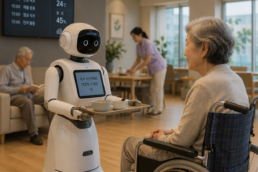
The first wave of dining automation in Korea was about serving, not cooking. These were the wheeled robots that glide between tables carrying plates, and they appeared in restaurants as early as 2019. Since then, they have become a familiar sight in everything from barbecue joints to screen-golf lounges.
The serving-robot wave
The market leader illustrates the scale. V.D. Company, the dominant domestic supplier, had deployed roughly 5,000 serving robots across about 3,000 venues by late 2023. At the same time, the number of merchants using its broader suite of automation tools, including tablet ordering and point-of-sale systems, surpassed 10,000. Notably, the company’s customer base has diversified well beyond restaurants. For instance, it now ships robots to cultural spaces like screen-golf ranges and even logistics centers.
The economics explain the appeal. Renting a serving robot and a set of tablets can cost around one million won per month. For that same money, a restaurant owner gets only a few days a week of a part-time human worker. As a benefit, the robot guarantees consistency, never calls in sick, and can run for as long as the lights stay on. Meanwhile, it frees human staff to focus on customers rather than ferrying dishes. The result is a clear return on investment that has driven adoption across the country.
Robot chefs enter the kitchen
The newer and more ambitious wave has moved into the kitchen itself. Here, the robots are not just carrying food. Instead, they are cooking it.
Fried chicken, one of Korea’s most beloved foods, has become an unlikely showcase. Kyochon F&B, a leading chicken chain, now runs robot cooks in a dozen outlets after expanding the program. The company partnered with the robotics firm Neuromeka to develop automated fryers. According to one franchise owner, the robots have not necessarily increased how many birds get fried per hour. However, they have made the work far easier, since staff no longer need to hover over bubbling oil and can instead handle sauces, cleaning, and customers. Likewise, rival chain BHC has rolled out automated frying robots developed with LG Electronics. The burger brand Lotteria, meanwhile, introduced its own automated fryers, and the family-restaurant chain VIPS has deployed noodle-cooking robots across most of its locations.
The reach extends beyond franchises. Large catering companies and highway rest stops, which serve enormous volumes of food, have embraced kitchen robots to cope with chronic staffing gaps. For example, food giant Pulmuone introduced a robotic wok at several rest-stop locations, where labor is especially scarce outside city centers.
The fully unmanned café
At the frontier sits the completely automated venue, where Better Than Yours points to a possible future. Launched in 2023 by the local robotics startup Robros, the café runs entirely on its two robot baristas. Together, they brew teas, coffee, and ice cream based on each visitor’s chosen recipe, down to the strength and toppings. Because the system calculates ingredient costs to the exact won, it can offer prices below those of a conventional café. As the company puts it, the robot baristas ensure consistency in every order while still accommodating custom requests. For a country wrestling with a labor crisis, the 24/7 unmanned model is more than a gimmick. Indeed, it is a glimpse of where the economics may ultimately lead.
The Big Money: How Conglomerates Are Betting on Robots
The most telling signal is not the robots themselves. Rather, it is where Korea’s largest companies are placing their money. In recent years, the country’s biggest conglomerates have moved aggressively to control the service-robotics supply chain, and the deals reveal how seriously they take this market.
LG Electronics has made the boldest play. In March 2024, the company invested $60 million in Bear Robotics, a Silicon Valley startup founded in 2017 by former Google engineer John Ha. Bear’s flagship product, Servi, delivers meals in restaurants across the United States, Korea, and Japan. Then, in January 2025, LG exercised a call option to raise its stake to a controlling 51 percent. According to TechCrunch, the deal reportedly valued Bear Robotics at around $600 million. As part of the move, LG folded its own CLOi service-robot line into Bear’s operations, signaling a long-term commitment rather than a quick financial bet.
LG was not alone. Around the same time, Samsung Electronics raised its stake in Rainbow Robotics, a Korean collaborative-robot maker, to roughly 35 percent, becoming its largest shareholder. Taken together, these two moves are telling. They show the country’s top electronics giants racing to own the platforms, software, and fleet-management systems that will run the next generation of service robots. For investors, the lesson echoes a pattern Seoulz has tracked among Korea’s hidden AI giants. The most durable value often sits in the infrastructure layer rather than the flashy front end.
Does the Math Actually Work?
For all the excitement, a fair question remains. Does automating a restaurant actually pay off? The honest answer is that it depends heavily on the setting, but the case is increasingly compelling.
Serving robots make the clearest economic sense in high-rent, high-wage districts where labor is both expensive and hard to find. Seoul’s dense restaurant neighborhoods fit that description perfectly. In these areas, a robot that costs roughly a million won a month can replace a meaningful chunk of labor spend while operating every hour the restaurant is open. Furthermore, the consistency argument matters more than it first appears. A robot barista pours the same drink every time, which reduces waste and customer complaints alike.
Kitchen automation tells a more nuanced story. As the Kyochon franchise owner candidly admitted, robot fryers do not always boost raw output. Nevertheless, they reduce the physical strain of the job and let a smaller team cover more ground. For a sector defined by thin margins and impossible hiring, that trade can be the difference between staying open and shutting down. In particular, the value shows up during peak hours, when machines grind away tirelessly while humans manage the rush.
The Backlash Nobody Photographs
No honest account of dining automation should ignore its human cost, and the friction is real. The glossy images of dancing robot baristas tell only one side of the story.
The clearest example comes from Korea’s highway rest stops. As Rest of World reported, the Munmak rest stop in mountainous Gangwon province replaced its kitchen with three robot chefs in early 2024. Before that, a human cook prepared regional specialties like makguksu, an earthy buckwheat-noodle dish that drew truck drivers from far away. After automation, however, the menu shifted toward easily automatable dishes such as ramen, udon, and standard stews. As a result, the local delicacies largely disappeared.
The impact on workers cuts deeper than the menu. Some kitchen staff told reporters they could work at a more relaxed pace alongside the tireless machines. Yet others spoke of layoffs and a loss of dignity, since their roles were downgraded from chefs to cleaning staff. In fact, several quit because they could not adjust to the menial nature of the new work. This tension captures the central paradox of Korea restaurant robots 2026. On one hand, automation genuinely solves a labor shortage in an aging nation. On the other hand, it hollows out the craft and culture that made the food worth traveling for in the first place. Diners have noticed too, leaving unhappy reviews about declining quality at automated venues.
These concerns connect to broader shifts Seoulz has explored in its analysis of the Korea 4.5-day workweek and the country’s rapidly expanding silver economy. In each case, a shrinking and aging workforce is forcing the nation to rethink how work itself gets done.
What Foreign Investors Should Watch in 2026
For anyone tracking this space from abroad, several themes deserve close attention this year.
First, watch the migration from serving robots to cooking robots. Industry analysts note that large-company investment is shifting away from simple delivery bots and toward collaborative cooking robots. At the same time, deployment is expanding into rest stops, train stations, and institutional catering. Because cooking automation is harder and more valuable, that is where the next margin pool likely sits.
Second, watch component localization. Korea leads the world in robot density, but it has long depended on imported parts for critical components like reducers and sensors. The government’s push to raise domestic production to 80 percent by 2030 creates a clear opportunity for suppliers who can fill that gap. Therefore, the parts layer may prove as investable as the robots themselves.
Third, watch the export play. Companies like Bear Robotics already operate in the United States and Japan, and Korean firms are using their dense home market as a proving ground before expanding overseas. Just as the country’s restaurant brands have gone global, its robotics platforms may follow the same path. For a deeper look at the policy backdrop, the government’s official InvestKorea portal tracks sector incentives in detail.
The Dining Lab of the Future
South Korea did not set out to become the world’s testing ground for restaurant automation. Instead, it arrived there through necessity, pushed by a demographic cliff that left employers with few alternatives. Now, the country is running an experiment that the rest of the world will be watching closely. If robots can profitably and palatably run a restaurant anywhere, they will do it first in Seoul.
The open question is not whether the machines work. By and large, they already do. The harder question is what a nation loses when the cook behind the counter becomes a robot that dances when no one is looking. For investors, the boom represents a rare chance to back a structural trend early. For diners, it represents a quieter trade-off between efficiency and soul. Either way, the future of eating is being prototyped right now, one automated bowl of ramen at a time.