

Three Pairs for 5,000 Won
You have probably bought them without thinking twice. A folding table outside a Myeongdong storefront, a hand-lettered cardboard sign, and a wall of socks stacked by pattern: strawberries, tigers, cartoon dogs, tiny embroidered kimchi jars. Three pairs for 5,000 won. Sometimes five for 10,000. You buy a handful, stuff them in your bag, and forget about them. That folding table is the front counter of the Korea sock industry.
That casual purchase is, in fact, the most visible surviving edge of a real manufacturing sector. Moreover, the Korea sock industry is so geographically concentrated that it barely fits the word “industry” at all. Almost every one of those socks was knitted within a few subway stops of one another. In addition, they came from one northern district of Seoul that most tourists never visit.
Meanwhile, that district has lost a third of its factories in four years.
This is the story of how one neighborhood came to make most of a country’s socks. It is also the story of why that neighborhood began dying just as the world discovered Korean fashion. Then came the summer of 2026. Suddenly, Korean shoppers wanted socks more than they had in a decade. Above all, it is a story about the strange gap between demand and the people who actually make things.
What the Korea Sock Industry Actually Looks Like
Start with the geography, because the geography is the whole story.
Sock manufacturing in Korea is not spread across the country. Instead, it is stacked into Dobong-gu, a residential district in Seoul’s far north, pressed up against the granite ridges of Dobongsan mountain. Walk through the Changdong area and you will pass apartment blocks, fried chicken shops, a discount supermarket. Then, behind an unmarked steel door on a semi-basement floor, forty knitting machines run at once.
The numbers vary depending on who is counting, and that variance matters. According to figures cited by Dobong-gu in 2024, Seoul accounts for 85.1 percent of national sock production. Dobong alone represents 69.9 percent of Seoul’s output. The Dobong Sock Manufacturers Association and the Seoul city government prefer a more conservative frame. Their figure puts Dobong at roughly 40 percent of all domestically produced socks, and above 70 percent of Seoul’s. Either way, the conclusion holds. For instance, no other Korean manufacturing category — not semiconductors, not cosmetics, not shipbuilding — is packed into one district at anything close to this density.
Definitions explain much of the gap. Statistics Korea counted about 170 registered sock manufacturers in Dobong in 2019, out of 247 across Seoul, using a narrow business-registration definition. Dobong-gu’s own tally, which includes the small unregistered workshops that do finishing, dyeing, and packing, ran considerably higher. In practice, both counts describe the same cluster; they simply draw the boundary in different places.
Why Dobong? The answer is unglamorous. Land was cheap in the 1970s and 1980s, the area sat outside the city’s tightest zoning, and knitting machines are loud. As a result, sock production settled where nobody complained. Families opened workshops in the ground floors of their own buildings. Sons inherited machines from fathers. Consequently, an entire supply chain — yarn suppliers, dyers, embroidery specialists, packaging printers — grew up within walking distance of itself.
That proximity was a genuine competitive advantage. A designer could sketch a sock in the morning, watch a sample knitted by afternoon, and place an order before dinner. Similar speed made Dongdaemun the fastest apparel engine in Asia. Dobong did the same thing, quietly, for one product.
How 302 Factories Became 200
Then the count started falling.
In 2019, Dobong-gu recorded 302 sock manufacturing businesses. By 2023, that number had dropped to 200 — a decline of roughly 33 percent in four years. Put differently, one in three sock factories in the capital of the Korea sock industry closed inside a single presidential term.
The closures were rarely dramatic. There were no mass layoffs, because most of these operations employ three to eight people. Instead, an owner in his sixties reached retirement, his children declined to take over, and the machines went to a scrap dealer or a broker in Vietnam. The building became a café or a studio apartment. Nobody wrote about it.
Rent tells part of the story. Seoul’s northern districts have gentrified more slowly than Seongsu or Mapo, yet they have still gentrified. Moreover, industrial space in Dobong now competes with residential redevelopment, and residential wins on price every time. Many manufacturers responded by relocating to Gyeonggi Province, where rent is lower but the cluster effect disappears. A factory that moves ninety minutes away loses the very thing that made it fast.
Labor tells another part. Sock knitting is skilled work that pays like unskilled work, which is a difficult combination in a country with Korea’s education levels. Younger Koreans do not enter the trade. Meanwhile, the foreign workers who fill similar roles in other manufacturing sectors are harder to place in micro-workshops, since visa quotas favor larger employers.
Still, neither rent nor labor was the decisive factor. The decisive factor arrived by container ship.
The Year Korean Socks Stopped Earning Money
Trade data draws the clearest line under the Korea sock industry.
In 2000, Korea exported $374.6 million worth of socks and hosiery. That figure held near the $300 million mark through 2006. Then it collapsed. By 2007, exports had fallen to roughly $200 million. By 2019, the annual total was $105.76 million — the weakest reading in four years at the time.
The American market shows the same curve in sharper relief. Korean sock exports to the United States were worth $96.4 million in 2016, then $73.19 million in 2019. According to UN COMTRADE data compiled by Trading Economics, U.S. imports of Korean pantyhose, tights, and socks totaled just $30.48 million in 2025. In other words, Korea’s largest export market shrank by roughly two-thirds in under a decade.
Above all, one number captures the reversal. In 2013, Korea ran a sock trade surplus of approximately $100 million. By 2022, that had become a $44.06 million deficit. A country that had exported socks for forty years became a net importer of them.
Russia offers a useful control case. In 2019, Korea shipped just $620,000 of socks to the Russian market. Turkey, competing for the same buyers in the same year, shipped $12.78 million — more than twenty times as much. Korean manufacturers were not losing to some unbeatable force of nature. Rather, they were losing to competitors with lower costs and better trade positioning, in a category where the buyer rarely knows or cares where the product was knitted.
For context on how global sock and hosiery trade flows have shifted, the Observatory of Economic Complexity tracks the category under HS code 6115.
Three Forces Squeezing Seoul Sock Factories
Three pressures, layered on top of each other, explain the decline of the Korea sock industry better than any single villain. Together, they hollowed out the Seoul sock factories from three directions at once.
China, and Then the Platforms
Chinese sock manufacturing undercut Korean production on labor cost decades ago. That much is familiar. However, the second wave was more damaging than the first. Chinese cross-border platforms removed the importer entirely, letting a Korean consumer buy directly from a factory in Zhejiang for a few hundred won per pair. By early 2026, AliExpress and Temu had reached 8.57 million and 8 million monthly active users in Korea. Our analysis of Korea’s C-commerce shift covers that surge in detail. Consequently, the domestic price floor fell through.
Korean manufacturers could not follow it down. A Dobong workshop paying Seoul rent and Korean wages cannot produce a sock that retails for 400 won.
Rent, Retirement, and the Missing Generation
The second pressure is demographic rather than economic. Cluster industries survive on succession, and Korean succession has broken down across small manufacturing. Furthermore, the same pattern is visible in Korea’s vintage clothing trade, where sorting and processing work depends heavily on workers over sixty. When those operators retire, the knowledge leaves with them. Machines can be bought; the ability to diagnose a dropped stitch by sound cannot.
The ESG Wall
The third pressure surprised everyone, and it deserves more attention than it has received.
European and American buyers have tightened environmental requirements substantially. ESG reporting standards and RE100 commitments now flow down the supply chain to suppliers of even minor product categories. Sock knitting, in particular, generates measurable waste — yarn ends, off-spec runs, dye effluent — and older machinery generates more of it. As a result, a growing number of overseas companies have stopped buying from producers whose equipment cannot meet those thresholds.
For a large exporter, retooling is a capital expenditure. For a six-person workshop in Changdong, it is an impossibility. Therefore, the ESG wall functioned as a quiet trade barrier, screening out precisely the small producers who had survived the first two pressures.
Meanwhile, Korea Started Wearing More Socks Than Ever
Here is where the story turns strange.
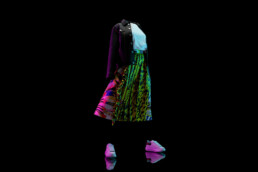
In the summer of 2026, Korean consumers developed an appetite for socks unlike anything in recent memory. The trend has a name: 발꾸 (balkku), roughly “foot decoration.” It follows the same grammar as phone-kku and bag-kku, the earlier waves of decorating one’s phone case and handbag. This time, the canvas is the foot.
The premise breaks a rule most Western readers absorbed in childhood: you do not wear socks with sandals. Seoul decided otherwise. Sheer socks under mesh flats, lace ankle socks with Mary Janes, half socks with loafers, and — most provocatively — socks worn deliberately with flip-flops.
The platform data is difficult to overstate. Compare June 1–21, 2026 with the same window a year earlier. On the fashion platform 29CM, searches for flip-flop socks rose 67-fold. Open-toe socks climbed 19-fold, while leg warmers gained 444 percent. On Zigzag, flip-flop sock searches rose 4,053 percent, half socks more than tenfold, and ring leg warmers 1,563 percent. Ably logged a 4,118 percent jump in flip-flop sock searches over a comparable period, alongside a 632 percent rise for open-toe styles.
Transactions followed the searches. Flip-flop sock sales rose 655 percent on 29CM. On Ably, sheer leg warmer sales climbed 614 percent, while half socks surged 2,162 percent.
Three forces drove it. First, high fashion supplied the license. Miu Miu’s 2025 S/S collection put open-toe socks on the runway. Meanwhile, The Row’s jelly sandals revived a silhouette that pairs naturally with visible hosiery. Second, K-pop supplied the demonstration. IVE’s Jang Won-young posted lace socks with Mary Janes; aespa’s Karina wore sheer socks through airport pickups; BLACKPINK’s Jennie appeared in both. Third, the weather cooperated in the worst possible way — Korea’s brutal summers made bare feet in shoes unpleasant, and a thin sock solved a practical problem while looking intentional.
Similar logic reshaped Korean beach fashion, where sun protection and modesty preferences produced a swimwear category that looks nothing like its Western equivalent.
Why a 4,000 Percent Spike Never Reaches the Knitting Machine
So the demand came back. Why, then, is the Korea sock industry still shrinking?
Because the money is not moving where you would assume.
Consider what a flip-flop sock actually is. It is a novelty item with a short seasonal window, an uncertain repeat rate, and a design that will look dated by next spring. Platform sellers meeting that demand need speed and low unit cost above all. Accordingly, most of them source from China. A factory there turns a viral silhouette into 50,000 units in under three weeks. No Korean workshop can match that price.
Dobong’s traditional advantage — proximity, fast sampling, small-batch flexibility — is real, but it was built for a different buyer. It served brands placing orders of a few thousand pairs with a season of lead time. By contrast, platform commerce wants either 300 pairs tomorrow or 100,000 pairs at three cents of margin, and Dobong is structurally wrong for both.
There is a branding problem underneath the logistics problem. Korean socks sell well precisely because they are cheap, cute, and anonymous. Nobody buying a 1,600-won cartoon sock asks who made it. Therefore, the manufacturers capture none of the brand premium that has lifted Musinsa’s global K-fashion push or the designer labels clustered around Itaewon. The socks are the most exported piece of Korean fashion by unit volume, and the least legible by name.
In short, a demand boom helps a category. It does not automatically help a country’s producers within that category. Dobong is learning the difference.
Dobong Socks Fight Back
The district has not accepted the outcome. Its counterattack on behalf of the Korea sock industry is more sophisticated than nostalgia.
The Seoul Dobong Sock Manufacturing Support Center, located in Changdong, operates as shared infrastructure for workshops too small to invest alone. It offers free prototype production for prospective buyers, access to automatic knitting and embroidery equipment, and design consultation. In addition, it runs training in CAD sock design and AI-based fashion visual marketing. That second course matters more than it sounds. Because of it, a two-person workshop can produce product imagery competitive with a funded brand.
A separate Dobong Sock Exchange Center opened on April 30, 2024, occupying 145.31 square meters. There, local manufacturers show finished goods rather than sample swatches.
Branding is the second front. The manufacturers’ association has been developing a shared Dobong brand built around the district’s mountain. The logic is straightforward. A collective mark can carry origin value that no six-person workshop could establish alone. Furthermore, the district has run public design competitions to pull outside creative talent back into the category. One recent contest offered a prize pool of 4.29 million won for sock illustration.
Export development is the third front, and it has produced the most concrete results. In April 2025, a Dobong trade mission traveled to Atlanta as part of the World Korean Business Convention. The delegation logged 81 B2B consultations worth approximately 5.1 billion won and signed 10 memoranda of understanding, including three with North American economic organizations.
Whether that converts into sustained orders remains genuinely unsettled. Trade missions generate consultations easily and contracts rarely. Even so, the strategic logic is sound. If Korean socks cannot win on price, they must win on design, small-batch flexibility, and verified origin. Those are the same arguments that have worked for Korean fashion-tech startups selling overseas.
A Foreigner’s Guide to Buying Korean Socks
If you want to buy Korean socks well, it helps to understand the tiers the Korea sock industry sells into.
The tourist tier. Myeongdong and Namdaemun Market run on bundle pricing: typically three to five pairs for 5,000 to 10,000 won. Quality is inconsistent but rarely bad, and the designs are the point. Namdaemun generally prices lower than Myeongdong for the same goods, since it sits closer to the wholesale layer. Bargaining works on volume, not on single pairs.
The convenience tier. Daiso stocks basic socks from about 1,000 to 2,000 won per pair, with reliable construction and conservative patterns. For plain black or white basics, this tier is difficult to beat anywhere in the world.
The design tier. Independent Korean sock brands sell through Musinsa’s global storefront, 29CM, and Zigzag, generally between 5,000 and 15,000 won per pair. Meanwhile, this is where the balkku trend actually lives — sheer socks, open-toe styles, lace trims, and the flip-flop socks that broke the search charts.
The experience tier. Seongsu-dong has become a destination for custom sock shops, where stores such as SIETE let customers pick a base sock and add embroidery on the spot. Expect 10,000 to 25,000 won and a short wait. As a souvenir, it beats a keychain considerably.
A note on origin. If buying Korean-made socks matters to you, look for 국산 or “Made in Korea” on the band. Be aware, however, that many socks sold in tourist districts are imported. The Dobong-affiliated makers increasingly label their origin, precisely because it has become a differentiator rather than an assumption.
Sizing note. Korean sock sizing typically runs in centimeter ranges, such as 220–250. Convert from your shoe size rather than guessing, since the elastic is often tighter than Western equivalents.
What Happens to the Last 200
For the Korea sock industry, the likeliest outcome is neither collapse nor revival. Instead, expect consolidation into something smaller and more deliberate.
Some workshops will close on schedule as their owners retire, and no policy will prevent that. Others will move to Gyeonggi and become quiet contract manufacturers, trading cluster speed for survivable rent. A third group — the one the support center is built for — will attempt to convert into small brands, selling design and origin rather than knitting capacity.
That third path is narrow, yet it is not fantasy. Korea has repeatedly turned unglamorous manufacturing into exportable identity. Socks carry unusual advantages for the trick: low shipping weight, high gift utility, near-universal sizing, and a design vocabulary that already travels. The Korean vintage clothing trade made a comparable jump from bulk commodity to branded pipeline within roughly a decade.
Meanwhile, the numbers to watch are simple. Does the Dobong business count stabilize above 150? Does the sock trade deficit narrow from its 2022 level? Do any Korean sock brands appear in overseas retail under their own name rather than as unlabeled wholesale? Answers to those three questions will settle the sector’s direction more honestly than any policy announcement.
For now, the Korea sock industry survives in a peculiar state: globally visible and locally invisible at once. Millions of visitors carry Korean socks home each year without a thought about their origin. Official data from Statistics Korea and the Seoul Metropolitan Government documents the shape of that trade. The socks travel further than almost any other Korean consumer product. The people who make them have never been further from the customer.
Next time you pay 5,000 won for three pairs, look at the band. Somebody in a semi-basement in northern Seoul may have made them, and there are fewer of those people every year.