

It is 3:40 in the morning, and the Dongdaemun fashion district should be roaring. A decade ago, this stretch behind the Dongdaemun Design Plaza ran on a strange, electric rhythm. Trucks idled. Dollies clattered over wet asphalt. Retail buyers from across the country hauled shrink-wrapped bundles into vans bound for provincial shops. The wholesale market here moved garments at a pace nowhere else in Asia could match. If a dress appeared on a K-drama on Monday, a copy could be hanging on a rack by Thursday.
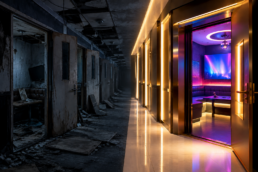
Tonight, however, several corridors sit half-dark. Some stalls are shuttered. Others glow with the cold light of a ring lamp. There, a seller livestreams to buyers in Shanghai and Ho Chi Minh City. The crowd that used to fill these aisles is mostly gone. This is the contradictory heart of Dongdaemun redevelopment 2026 — a district that is, depending on where you stand, either dying or being reborn. In fact, it is doing both at once. That paradox is exactly what makes it one of the most fascinating stories in Seoul right now.
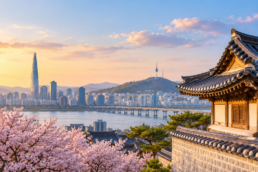
For most foreign visitors, Dongdaemun registers as a late-night shopping curiosity. It’s a place to buy cheap clothes at 2 a.m. and admire Zaha Hadid’s silver spaceship. Yet beneath that tourist-facing surface, a far bigger transformation is underway. The old engine of Korean fashion is sputtering. Meanwhile, the Seoul city government is pouring billions of won into rebuilding the area around it. To understand where this district is heading, you have to understand both forces at once.
Why Dongdaemun Matters More Than Tourists Realize
Before the decline and the redevelopment, some context helps, because Dongdaemun is widely misread by outsiders. Most travelers picture a single neon shopping street. In reality, it is a sprawling industrial ecosystem. According to the Dongdaemun Market entry on Wikipedia, the district packs roughly 26 shopping malls into a few dense blocks. It also holds around 30,000 specialty shops and tens of thousands of manufacturers, straddling the Jongno and Jung districts.
This is not just retail. Instead, it is a vertically integrated fashion machine. Fabric wholesalers, sewing factories, material suppliers, designers, and logistics crews all cluster within walking distance. As a result, the area can turn a sketch into a finished, shippable garment in days. That speed built modern Korean fashion long before the term “K-fashion” existed. We mapped part of this digital layer earlier in our look at Korea’s top tech fashion startups. Many of them exist specifically to wire Dongdaemun’s chaotic supply chain into the internet.
For decades, this concentration looked unbeatable. After all, no rival could match the combination of scale, speed, and price. That assumption is precisely what has broken — and the cracks now run deep.
From Refugee Market to Wholesale Empire: A Century of Reinvention
To grasp why the current moment matters, it helps to remember that Dongdaemun has never sat still. The market traces its origins to 1905, when Korean merchants opened what is now Gwangjang Market — Seoul’s first permanent, privately run marketplace, founded partly to push back against Japanese commercial dominance. That detail comes from the Dongdaemun Market entry on Wikipedia and matches accounts in the Korea Times.
The Korean War nearly erased it. The market was destroyed in the fighting, then slowly rebuilt through the late 1950s. Meanwhile, displaced North Korean refugees settled in shacks along the Cheonggye Stream just to the east. Armed with little more than sewing machines, they began stitching garments from surplus U.S. army uniforms. As Seoul’s official travel guide recounts, this is how the legendary Pyeonghwa (“Peace”) Market was born — named in the hope that no further wars would scar Korean soil.
From those humble beginnings, the district became an industrial juggernaut. By the 1970s, Dongdaemun handled a huge share of the country’s clothing production and distribution. Then, in the late 1990s, a wave of high-rise malls — Migliore in 1998, Doota in 1999 — transformed the gritty wholesale zone into a glossy 24-hour shopping town. The city even declared a Dongdaemun Fashion Town Special Tourist Zone to court the rising flood of foreign buyers.
The pattern is unmistakable. Refugee market, then sewing district, then wholesale empire, then tourist landmark. Each era looked permanent until it wasn’t. Seen against that history, today’s upheaval is less an ending than the latest turn of a very old wheel. Indeed, this district has always rebuilt itself around whatever the economy demanded next.
The Fall: When the Fashion Engine Started to Stall
Let’s start with the data, because this is where the story stops being anecdotal. The clearest signal of distress is vacancy. According to reporting by KED Global, the Maxtyle shopping mall was built to house more than 2,600 stores. Its vacancy rate climbed to a staggering 86%. Two other major fashion malls, Designer Club and Good Morning City, reported vacancies of 77% and 70% respectively. In other words, entire buildings that once anchored the district now stand mostly empty.
The causes are not mysterious. First, and most importantly, cheap Chinese imports flooded the market. Apparel imports into Korea surged from roughly $9.73 billion in 2020 to nearly $12.98 billion by 2024. That figure comes from data cited by Seoul Economic Daily. Low-cost platforms — Alibaba, Temu, and Shein, collectively nicknamed “AliTeSh” — let Korean retailers order similar styles straight from Chinese factories. The prices undercut Dongdaemun by a wide margin. As one fashion-industry official bluntly put it, if you can order near-identical clothes from AliExpress or Temu, the reason to visit Dongdaemun starts to disappear.
Second, the platforms that were supposed to save Dongdaemun by digitizing it instead collapsed under the same pressure. Take Linkshops, the pioneering B2B platform that put thousands of Dongdaemun wholesalers online. It raised close to 20 billion won and once looked like the district’s digital future. We covered its rise in detail when it was still ascendant, in our piece on how Linkshops put Dongdaemun online. However, transaction volumes dried up, and the company shut down. Gollala, another wholesale platform, folded as well. When even the digital intermediaries can’t survive, the underlying business is clearly in trouble.
Third, consumer behavior shifted permanently. The pandemic accelerated a move toward online shopping that was already underway. We documented that transition in our coverage of how shopping habits in Korea changed. Meanwhile, China’s earlier ban on group tours and the loss of bulk retail buyers gutted the foot traffic that justified Dongdaemun’s premium rents. In response, landlords now offer rent-free leases where tenants pay only management fees. Even then, they struggle to fill the space.
The pain reaches all the way down the supply chain. In the nearby Changsin-dong sewing district, one factory owner told Seoul Economic Daily that her client base had shrunk from more than 20 to just three. The garment ateliers that made Dongdaemun’s speed possible are quietly going dark, one ironing board at a time.
What Dongdaemun Looks Like Today: Less Hype, More Business
So is Dongdaemun finished? Not exactly. Its role has changed rather than vanished. The trend buzz that once lived here has migrated to neighborhoods like Seongsu, Hannam-dong, and Hongdae. We explored that gravitational shift in our foreign brand’s playbook for Seongsu. There, pop-ups and flagships now manufacture the novelty that keeps a district culturally alive.
Dongdaemun, by contrast, has become less a destination and more an engine room. The wholesale zone behind the DDP still generates an estimated $15 billion in annual transactions. The old “if you saw it on a K-drama, it’s on a rack within 72 hours” system still functions. Yet the energy has changed. Walk through at the so-called “Golden Time” between 11 p.m. and 2 a.m. You’ll see fewer provincial buyers and far more sellers livestreaming to overseas audiences. Chinese and Southeast Asian resellers now run ring-light operations directly from the stalls. In effect, they turn a physical wholesale market into a live-commerce studio.
This digital pivot connects Dongdaemun to a much larger story. Live commerce has become one of the defining battlegrounds of Korean retail. We detailed that fight in our breakdown of Korea’s fashion platform war. Notably, ABLY — now one of the country’s largest fashion platforms — began life as a marketplace for exactly these Dongdaemun-based apparel shops. In a sense, the district didn’t disappear; it dissolved into the apps.
The Master Plan: Why Seoul’s Urban Renewal Bets Billions on a Comeback
Here is where the paradox sharpens. Even as the wholesale market contracts, the Seoul city government is moving aggressively to rebuild the area around it. This wave of Seoul urban renewal is unusually direct. In February 2025, the city unveiled an ambitious master plan. The goal was to rejuvenate the zones surrounding the Dongdaemun Design Plaza, a former stronghold of Korean fashion that had struggled badly in recent years. As reported by AJU Press, the initiative aims to revive the aging hub through urban-renewal projects and infrastructure upgrades. These include green corridors linking the DDP to nearby parks.
The DDP itself is the proof of concept. It was built on the demolished site of the old Dongdaemun Stadium and opened in 2014. Since then, it has become one of Seoul’s signature landmarks. According to the Seoul Metropolitan Government, the complex drew 10 million visitors within four years of opening. It then surpassed 100 million cumulative visitors by 2024, and now attracts well over 13 million people a year. For a structure once derided as an “alien spaceship,” that is a remarkable return on a controversial bet.
The redevelopment, however, extends far beyond the DDP. Several distinct projects are reshaping the broader Dongdaemun corridor at once:
- Hyoje-dong urban redevelopment. In late 2025, the city approved a redevelopment plan covering the Hyoje-dong area near Jongno. It forms part of a broader effort to revitalize central Seoul’s underdeveloped east. As Asia Business Daily reported, roughly 1.08 million square meters in the wider Dongdaemun area were re-designated as planned redevelopment zones. Incentives were attached to protect the district’s traditional pharmaceutical businesses and its commercial tenants.
- Cheongnyangni high-rise push. In the Cheongnyangni redevelopment district, the city relaxed height limits dramatically. The cap rose from about 90 meters and 27 floors up to 155 meters and 49 floors. That change clears the way for towers that will reshape the skyline of northeastern Seoul, again per Asia Business Daily.
- The Hongneung future-city blueprint. Slightly to the north, the Hongneung research cluster is being reimagined as a digital-healthcare and bio hub. It is anchored by Korea University, Kyung Hee University, and KIST. The Seoul government plans to invest roughly 20 billion won between 2026 and 2030 on the next phase of the project.
- A northeastern cultural axis. Seoul is also betting heavily on culture-led growth in its northern districts. Its plans explicitly link new K-pop and live-entertainment venues to existing landmarks like the DDP, as the Korea Herald reported.
Taken together, these are not cosmetic tweaks. Instead, they represent a deliberate attempt to convert Dongdaemun from a fading wholesale bazaar into a mixed-use district of housing, research, culture, and tourism.
The Investor Angle: Who Actually Wins Here?
For foreign investors and would-be Seoul residents, the obvious question is who benefits from all this. The honest answer is that the bets are still unproven — but the contours are visible.
Real estate is the most direct play. Height-limit relaxations in Cheongnyangni and the formal redevelopment designation of Hyoje-dong unlock large-scale development. That simply wasn’t possible under the old building-by-building permit regime. For context, this mirrors a broader pattern across Seoul. The city has eased blight thresholds and commercial-quota rules to accelerate redevelopment north of the Han River. When zoning loosens and public money flows in, land values tend to follow.
Tourism and retail represent a second bet. Districts that manufacture experiences are winning, while fixed, commodity-driven shopping zones lose. We saw the dark side of this dynamic in our analysis of Sinchon’s retail collapse. We saw it again in the reshuffling of Seoul’s commercial map in our look at the Korea duty-free crisis. Notably, Hyundai shuttered its Dongdaemun duty-free store in 2025. The lesson is consistent: foot traffic now follows novelty and content, not legacy reputation. If the DDP-anchored redevelopment makes Dongdaemun a genuine experience destination, the upside is real. If it merely adds more generic retail, the area risks repeating Sinchon’s fate.
The third bet is industrial. The Hongneung digital-healthcare cluster and the live-commerce migration point in the same direction. Together, they suggest that Dongdaemun’s future value may lie less in selling clothes and more in producing content, research, and software around fashion and health. For investors who track Korean startups, that reframes the district as infrastructure rather than retail.
Three Scenarios for Dongdaemun in 2030
Where does all this land? Broadly, three futures are plausible.
In the first scenario — call it the managed revival — the redevelopment works largely as intended. New residential towers, the Hongneung bio cluster, and a culture-led DDP corridor bring fresh foot traffic and capital. The wholesale market shrinks but survives as a smaller, more specialized, more digital operation. Dongdaemun becomes a mixed-use district that happens to have fashion roots. In effect, it follows the path many Western garment districts took as they evolved into design-and-media zones.
In the second scenario — the hollowed-out landmark — the physical redevelopment proceeds, but the fashion economy keeps eroding faster than new industries arrive. The DDP thrives as a tourist island. Meanwhile, the surrounding wholesale buildings empty out, leaving a polished surface over a hollow core.
In the third scenario — the digital phoenix — the live-commerce pivot proves to be the real comeback. Dongdaemun’s unparalleled speed and density find a second life. The district becomes a logistics-and-content hub for fashion sold across Asia online. In this version, the physical market acts as a studio, showroom, and fulfillment node rather than a retail floor.
Realistically, the truth will likely blend all three, unevenly, block by block. Some wholesale corridors may hollow while the DDP axis revives. The live-commerce studios may flourish even as the sewing ateliers vanish for good.
What This Means If You’re Visiting, Buying, or Building There
For most readers, the abstract debate over the district’s future eventually becomes a concrete question: what should I actually do with Dongdaemun right now? The answer depends on who you are.
If you are a traveler, adjust your expectations. After all, Dongdaemun is no longer where Seoul goes to see what’s cool. For that, head to Seongsu or Hongdae instead. However, it remains a fascinating window into how Korean fashion is actually made. Visit the wholesale zone late, ideally between 11 p.m. and 2 a.m., and treat it as industrial tourism rather than a shopping spree. The retail malls like Doota offer fixed prices and an easier entry point for first-timers.
If you are a small buyer or aspiring brand, the calculus has changed. For instance, the wholesale system still runs on minimum order quantities, so casual single-item shopping is hard. Yet the same digital tools that disrupted Dongdaemun now make sourcing from it easier than ever from abroad. As a result, the live-commerce sellers and surviving platforms have, in effect, turned the market into something you can partly access through a screen.
If you are an investor or a foreigner weighing a move to Seoul, watch the redevelopment timelines rather than the storefronts. The Hyoje-dong designation, the Cheongnyangni height changes, and the Hongneung blueprint will play out over years, not months. As we noted in our breakdown of Korea’s fashion platform war, the real opportunity may sit in the software and logistics layer wrapping the old market, not in the aging malls themselves. The smart money is reading zoning maps, not price tags.
What makes Dongdaemun redevelopment 2026 so compelling is that it refuses to fit a single narrative. This is simultaneously a story of decline — empty malls, dead platforms, fading factories. At the same time, it is a story of reinvention, backed by serious public money and a clear municipal vision. Many foreign observers still think of Dongdaemun as a quirky night market. The bigger picture is that one of Asia’s most important fashion districts is being rebuilt in real time, with the outcome genuinely uncertain.
That uncertainty is the point. Dongdaemun has reinvented itself before — from postwar refugee market to wholesale empire to tourist landmark. Its next act could be a managed revival, a hollow shell, or a digital phoenix. Whichever it turns out to be, the answer will say a great deal about how Seoul, and Korea, choose to value the places where their modern economy was built. For now, the lights still flicker on at 3 a.m. — just for a different audience than before.