

On a grey Tuesday morning in Pangyo, a founder from Lagos steps off the subway with two suitcases and a pitch deck. She has never set foot in Korea before. Within three months, she will have a registered company, a startup visa, free office space, and a meeting scheduled with a Samsung corporate venture team. The Korea startup ecosystem 2026 has been engineered, quite deliberately, to make that exact sequence possible. However, the part of the story that matters most begins after the welcome ends. That is the part almost nobody explains to foreign founders before they arrive.
This guide walks through both halves. First, the extraordinary machine Korea has built to pull global entrepreneurs in. Then, the harder reality of what it actually takes to stay, fund, and scale once the program lights dim.
The $2.6 Billion Invitation
Let’s start with the number that frames everything. In 2026, South Korea’s Ministry of SMEs and Startups committed roughly ₩3.46 trillion — about $2.6 billion. That money spreads across 508 separate support programs run by 111 different institutions. For context, that is one of the most heavily state-backed startup environments in the advanced economy world. Moreover, it is not a one-off. Korea has poured close to $2 billion a year into its startup base since 2013, and the 2026 figure represents an acceleration rather than a peak.
What makes this interesting for a non-Korean founder is intent. A large slice of that capital is aimed specifically at pulling foreign teams into the country. In other words, this is not a domestic-only subsidy that outsiders happen to glimpse from the sidelines. Instead, Korea is openly courting global entrepreneurs as long-term contributors to its innovation economy. As a result, the door is genuinely open in a way it simply was not a decade ago.
For a sense of how this fits Korea’s broader capital pivot, Seoulz has covered the Korea pension fund venture turn that is reshaping where state money flows. The foreign-founder push sits inside that larger strategy.
Why Korea, And Why Now
The case for Seoul is no longer a leap of faith. According to Startup Genome’s most recent global ranking, Seoul sits at #8 worldwide among startup ecosystems. It ranks first globally in knowledge accumulation, and fifth in funding strength. The ecosystem’s total value is estimated at roughly $133 billion, with 14 active unicorns and exits worth a combined $121 billion over five years. These are not the numbers of an emerging market hoping to be noticed. They describe a mature hub that has quietly arrived.
The growth curve underneath those figures is even more telling. A decade ago, Korea had around 200 scaleups. By 2025, that count had passed 2,100. In short, this is a market built for company growth, not merely company formation. For deep-tech founders in particular, that distinction is everything, because deep tech needs patient infrastructure rather than quick consumer adoption.
Three structural advantages stand out. First, talent: Korea offers a deep pool of engineers, and software salaries average a relatively affordable $47,500. Second, the chaebol dynamic. Samsung, Hyundai, LG, SK, Kakao, and Naver all run active corporate venture arms, and they buy, invest, and partner aggressively. Consequently, Korea is an unusually exit-rich environment for B2B startups. Third, industrial depth. For robotics, semiconductor AI, and advanced manufacturing, Korea provides hardware ecosystems that few other countries can match at this density.
There is also a softer pull. K-culture has bent global attention toward Seoul, and that halo now extends into business. A founder pitching a Korean partner in 2026 arrives with more context, and less friction, than one would have a few years ago.
The Money On The Table
Here is where the ecosystem becomes concrete. For a foreign founder, several distinct funding channels run in parallel, and understanding the difference matters.
The headline program is the K-Startup Grand Challenge, or KSGC. Run by the Ministry of SMEs and Startups together with KISED, it has operated since 2016 out of Pangyo Techno Valley, Korea’s answer to Silicon Valley. The 2025 edition drew 2,626 applications from 97 countries, which gives a sense of how competitive the funnel has become. For 2026, the program selects roughly 80 international teams in its general track, plus a newly added cohort of about 20 international-student founders.
The structure runs across three phases over eleven months, delivered entirely in English. During the Discover phase, teams validate product-market fit remotely. Next, in the Accelerate phase, selected teams relocate to Korea for intensive in-country programming. Finally, on Demo Day, the top performers pitch for additional capital. Crucially, the top 20 teams receive prize money ranging from ₩5 million to ₩100 million. On top of that, the top 8 secure further commercialization grants of up to ₩50 million each. In addition, 40 teams receive up to ₩8 million per team to offset travel and accommodation for program visits.
Beyond KSGC, a second channel targets founders who want non-dilutive capital with less competition. Korea’s Global Startup Commercialization Program expanded in 2026 to back roughly 15 foreign-founded companies. Each is eligible for average funding of ₩50 million, and up to ₩80 million. That money supports product development, business-model localization, intellectual property, and marketing. Notably, this funding is non-dilutive, which means founders give up no equity to receive it.
A third lever sits underneath everything: the broader venture pool. Korea announced plans to create ₩4.4 trillion in venture funds for 2026, supported by ₩2.1 trillion in Fund of Funds contributions. This is public capital designed explicitly to crowd in private money, and it shapes the follow-on environment that founders eventually graduate into.
One more detail rewards attention. Government grants scale upward outside Seoul. For instance, a deep-tech team in Seoul might qualify for ₩300 million in seed funding. The same team based in Daejeon qualifies for ₩390 million — roughly 30 percent more, with far less competition for each slot. Therefore, the “obvious” choice of Seoul is not always the optimal one, and savvy founders weigh the trade-off carefully.
The Visa Maze, Decoded
Winning funding is step one. Legally building a company in Korea is step two, and this is where many foreign founders get stuck. The visa landscape looks intimidating from the outside, yet it follows a fairly logical sequence once decoded.
The two anchors are the D-10-2 and the D-8-4. A Korea startup visa pathway typically begins with the D-10-2, a startup-preparation visa for idea-stage founders who are still validating and setting up. From there, founders transition to the D-8-4, the technology startup visa for those who can prove genuine innovation and meet local criteria. Inside KSGC specifically, Phase 2 participants receive D-10-2 support, and Phase 3 teams move to the D-8-4.
Running alongside these is OASIS, a points-based system that scores founders on factors such as education, program participation, and the strength of their technology. Participation in a recognized program like KSGC can meaningfully strengthen an OASIS evaluation. For founders entering the structured D-8-4 track, the minimum capital requirement is ₩10 million — around $7,500. Helpfully, grant funds can be used to cover it.
There is a strategic point that experienced founders stress repeatedly. Plan the visa before incorporation, not after. The reason is that visa status affects shareholding structure, representative-director status, and employment contracts. Get the sequence wrong, and unwinding it later becomes expensive and slow. Korea has also layered on faster lanes for high-skill talent. One example is the K-Tech Pass program, launched in 2025. It offers expedited visas and an accelerated route to F-2 residency after one year rather than three.
For a fuller picture of the official channels, the Startup Korea portal maintains current program and visa details.
Where Founders Actually Land
Geography in Korea’s startup world is unusually concentrated, which is good news for newcomers. Unlike the sprawling ecosystems of the United States or India, the overwhelming majority of Korean startup activity clusters in a handful of districts. Practically speaking, that means a founder can build a targeted network without burning months on travel.
Gangnam, in southern Seoul, functions as the commercial heart — investors, buyers, and operators all concentrate there. Pangyo Techno Valley, just south in Seongnam, adds technical depth and houses much of the country’s serious engineering muscle. Meanwhile, Daejeon supports research-linked, science-heavy innovation, anchored by its deep institutional base. Each hub plays a distinct role, and Korea’s compact geography lets founders move between them with ease.
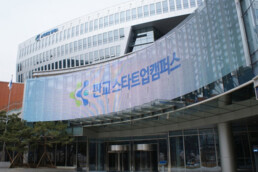
The on-the-ground infrastructure has expanded too. The Global Startup Center provides foreign founders with workspace, corporate-partnership matching, investor introductions, and administrative help on visas and company setup. Seoul is also building toward the future. The city plans to open the Seoul Unicorn Startup Hub, a 100,000-square-meter campus in Seongsu-dong, by 2030. The facility is designed to host around 1,000 startups under one roof. For founders, the practical takeaway is simple — landing somewhere with built-in support beats arriving cold.
The Part Nobody Tells You
Now the harder half. Everything described so far makes Korea easy to enter. None of it guarantees that a foreign startup can actually survive and scale once the program ends. This gap is the single most important thing a founder should understand before booking a flight, and it rarely appears in the promotional brochures.
Multiple founders who have been through the system describe the same reality. After the demo days, introductions, and grant money, long-term success depends far less on access to programs. Instead, it hinges on whether a company can integrate into Korea’s broader business environment. Ravi Shankar Pandit, founder and CEO of Konnect and a recent KSGC winner, put it bluntly when interviewed about the experience. In his framing, attracting founders alone does not determine long-term outcomes. Instead, two things decide it: access to follow-on funding, and the willingness of Korean companies to work with international entrepreneurs beyond the initial introductions.
Both of those are genuine walls. On funding, the early-stage environment is generous, but the step up to Series A and beyond is harder for foreign teams without deep local networks. On corporate openness, Korean enterprises can be conservative about committing real budget to an unfamiliar foreign vendor, however impressive the technology. A proof-of-concept project is one thing; a signed enterprise contract with meaningful revenue is another entirely.
Even Korea’s own policy analysts flag the risk. The 2026 strategy marks a clear shift from uniform, entry-heavy support toward selective, performance-linked growth support. Yet the policy documents themselves acknowledge that the system can fragment if early-stage screening, regional programs, and scale-up tracks fail to connect operationally. In plain terms, the on-ramp is excellent, but the highway beyond it is still under construction.
This is not a reason to avoid Korea. Rather, it is a reason to arrive with clear eyes and a plan for what happens in month twelve, not just month one.
The Founders Who Made It Work
So who actually breaks through? The pattern among successful foreign teams is remarkably consistent. It can be summarized in a single discipline: pick one niche, validate one use case, and build one local relationship before expanding wider. Korean market entry rewards precision and punishes vague ambition.
Consider a representative case. A Mumbai-based AI company opened a Seoul office specifically to access Korean enterprise clients. Rather than scattering effort, the team used a government program to de-risk its market entry before committing full resources. As a result, it landed three Korean enterprise contracts worth a combined ₩500 million in annual recurring revenue, plus a Series A round raised from a mix of Korean and Indian investors. What made the difference was sequencing — proving the model inside one tightly defined use case first, then scaling from a position of evidence.
A deeper lesson sits underneath that story. Korea functions best as a deployment market for foreign deep tech, not merely a funding source. Its most successful inbound startups integrate directly into hospitals, transport authorities, data centers, and enterprise workflows. That “retail-ready” posture creates real opportunity, because it ties a startup’s value to a concrete Korean buyer rather than an abstract pitch. For founders in AI specifically, Seoulz has profiled the Korean AI startups making global traction and the AI chip players betting against Nvidia, both of which show what local-market validation looks like at scale.
The 2026 Playbook
For founders ready to move, the path compresses into five concrete steps.
First, identify the right entry program. Apply to KSGC, the 15-team Global Startup Commercialization drive, or another MSS-backed channel that fits the company’s stage and sector. Second, secure the visa before anything else — the D-10-2 for idea-stage entry, or the OASIS-backed D-8-4 track for a structured pathway. Third, register the entity, remembering that the OASIS-track minimum capital is roughly ₩10 million and grant funds can cover it. Fourth, establish operations through a Global Startup Center, which offers free or subsidized workspace in Seoul and regional cities. Fifth, connect into the full ecosystem, using the dedicated managers who link foreign founders directly to investors and corporate partners.
Throughout, weigh the regional question honestly. Seoul delivers the fastest access to investors and talent, whereas regional cities such as Daejeon offer more capital and less competition. For deep-tech ventures with long development cycles, that trade-off can decide the outcome. Korea’s quantum sector offers a live example of regional, research-linked depth; Seoulz has mapped the Korea quantum computing landscape for founders weighing where to base hardware-heavy work.
The Verdict For Foreign Founders And Investors
For foreign founders, the Korea startup ecosystem 2026 offers something rare. A government will actively pay, house, and visa a global team into the market. Behind it sits one of the most generous public-capital engines in the developed world. The entry barriers have fallen dramatically. For B2B and deep-tech builders, the combination of chaebol demand, engineering talent, and industrial depth is genuinely compelling.
Yet the honest verdict carries a caveat. Entry is solved; absorption is not. The founders who win in Korea treat the government programs as a launchpad rather than a destination. From day one, they plan for the funding gap and the corporate-openness challenge that arrive after the applause fades. For investors, the same dynamic signals a maturing market. State co-investment and structured scale-up pipelines are aligning with global norms, yet execution risk remains real.
Korea leans harder on direct state capital than market-shaping models like Israel’s, and that is a riskier posture. However, Korea also starts with advantages neither comparison country had. It has world-leading chip manufacturers, a vast engineering base, and the cultural pull of Seoul drawing global attention. Whether those edges outweigh the dangers of state dependency is precisely the question the rest of this decade will answer. For any foreign founder weighing the leap, the message is clear. The invitation is real, and the money is real. The only thing the brochures leave out is the work that begins after you say yes.