

Somewhere in Chungcheong province, an 18-hole course with a clubhouse worth more than most Seoul apartment towers is sitting on the market. The asking price started near ₩250 billion. Then it dropped to ₩200 billion. Even so, the private equity firm that spent months looking at it walked away — because the drive from Seoul was fifteen minutes too long.
That single deal explains more about the Korea golf industry in 2026 than any tourism brochure ever will. For roughly three years, this country ran the most profitable golf boom on earth. Pandemic border closures trapped millions of Koreans at home, and golf became the only socially acceptable way to spend money outdoors. Green fees doubled. Golf wear turned into a luxury category. Course owners printed money.
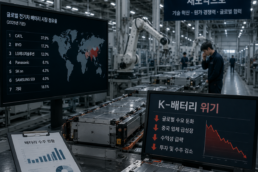
However, the correction arrived quietly, and it is still going. Visitor numbers have now fallen for three consecutive years. Golf wear has shed nearly a fifth of its market value. Meanwhile, course operators who once cleared 45% operating margins are scraping by on 20%. Notably, almost none of this has been reported in English, where coverage of Korean golf still leans on the same admiring cliché: these people are obsessed.
They are. golf.com once called it a national “fixation,” and the description holds. Yet obsession and economics are different things — and right now, only one of them is holding up.
How the Korea Golf Industry Got So Big, So Fast
Start with the geography, because it explains the pricing.
South Korea is roughly the size of Indiana, and about 70% of it is mountainous. Consequently, buildable flat land is scarce and expensive. A golf course here is not a leisure asset carved out of cheap farmland. Instead, it is a very large piece of real estate that had to be blasted, terraced, and drained into existence.
That cost structure was always there. What changed in 2020 was demand.
Before then, Korean golf ran on a different engine entirely: business entertainment. For decades, a round of golf functioned as the country’s premier venue for corporate relationship-building. Deals moved on the fairway. Membership at the right club signaled corporate rank as reliably as a job title. Consequently, course economics depended less on individual hobbyists than on expense accounts.
That model narrowed after 2016, when Korea’s anti-graft law placed hard limits on entertaining public officials. Corporate golf did not disappear, but it stopped being the industry’s growth story. In hindsight, the sector was already looking for a new customer base when the pandemic delivered one.
When international travel stopped, Korean discretionary spending had nowhere to go. Golf absorbed an enormous share of it. As a result, the total market — green fees, cart fees, caddie fees, and food and beverage combined — hit ₩9.44 trillion by 2022, or roughly $6.5 billion. That figure was up 58.9% from 2019 in just three years.
Public courses took ₩4.94 trillion of that. Member courses took ₩2.65 trillion. Caddie fees alone accounted for ₩1.72 trillion, which is a remarkable number for a service line item.
![INFOGRAPHIC 1 — Korea golf course visitors, 2021 to 2025]
Moreover, the boom pulled in a demographic that Korean golf had never really served. Historically, the game belonged to middle-aged businessmen conducting relationships on the fairway. Suddenly, though, it belonged to twenty-somethings posting outfit photos. Golf wear brands multiplied. Screen golf venues filled up on weeknights. For a brief window, golf was simultaneously a sport, a status symbol, and a content genre.
Foreign observers noticed the surface of this. Golf Post described it as “the two faces of golf in South Korea” — elite country clubs on one side, mass-market simulator bays on the other. Nevertheless, the financial machinery underneath went largely unexamined abroad.
The Three-Year Slide Inside the Korean Golf Market
Here is where the story turns.
According to the Korea Golf Course Business Association, national course visits peaked in 2022 at about 50.58 million. Since then, the direction has been consistent:
| Year | Course visits |
|---|---|
| 2021 | 50.56 million |
| 2022 | 50.58 million (peak) |
| 2023 | 47.72 million |
| 2024 | 47.41 million |
| 2025 | 46.41 million |
In other words, the market has given back roughly 4.2 million rounds since the peak — a decline of about 8%. Furthermore, 2025 alone accounted for a full million of that drop.
The per-hole numbers tell a sharper story. Average visitors per hole fell to 4,430 in 2025, down from 4,557 the year before. Member courses averaged 4,199 per hole; public courses managed 4,544.
Crucially, supply moved in the opposite direction. Korea had 527 operating courses as of January 2026, with another 11 under construction and 8 more approved. Total hole count kept climbing even as demand fell. Therefore, the squeeze was structural rather than seasonal — more capacity chasing fewer golfers.
Regional divergence made it worse. Gyeongbuk courses averaged 5,843 visitors per hole, while Jeju sank to 3,069, a 7% annual decline. Jeju’s problem is straightforward: once flights resumed, a golf trip to Vietnam or Japan started costing less than a weekend on the island.
Why Korean Golf Courses Never Cut Their Prices
Logically, falling demand should push prices down. In the Korea golf industry, that did not happen — at least not on the headline number.
As of May 2026, member courses charged non-members an average of ₩217,100 on weekdays and ₩268,700 on weekends. Public courses, which exist under a policy framework specifically designed to be cheaper, frequently charged more. Some ran to ₩270,000 on weekdays and ₩360,000 on weekends.
Read that again, because it is the strangest fact in Korean leisure economics. Fifteen public courses in the Seoul metropolitan area now charge higher weekday rates than nearby member clubs. Twenty-five exceed them on weekends.
How did that happen? Between 2020 and 2023, public course weekday green fees rose 31.7%, an increase of ₩41,400 per round. Weekend rates rose 22.8%. By contrast, member courses raised non-member rates 19.7% and 16.4% over the same period. In short, the courses that were supposed to democratize golf raised prices fastest.
Add the extras and the real cost becomes clearer. Cart fees, caddie fees split among the group, food, and the drive itself push a routine weekend round past ₩400,000 per person at many metro-area courses. For comparison, that is roughly what a month of Korea’s famously cheap gym memberships costs several times over.
![INFOGRAPHIC 2 — Korea golf market composition, ₩9.44 trillion]
The Caddie Question Every Foreign Golfer Asks
Nothing confuses visiting golfers more than the Korean caddie system, so it deserves its own explanation.
At most Korean courses, a caddie has traditionally been mandatory rather than optional. One caddie handles a group of four, drives the cart, reads greens, and manages pace of play. The fee is paid by the group, in cash, directly to the caddie at the end of the round. Historically, it did not even appear on the clubhouse bill.
The amounts are not small. As of mid-2026, the national average caddie fee at public courses reached ₩147,000 per group, rising to ₩152,500 in the Seoul metropolitan area. Split four ways, that is roughly ₩37,000 per person on top of everything else.
More striking is the escalation. Over the past twenty years, caddie fees climbed 79.7% — faster than weekday green fees at 63.5% and cart fees at 58.6%. The ₩150,000 tier illustrates the speed. In 2021, only four courses nationwide charged that much. By June 2026, 306 courses did. A ₩160,000 tier barely existed in 2023 with a single course; now 36 charge it.
Predictably, golfers revolted. The result is the fastest structural change in Korean course operations in decades.
Caddie-optional systems now operate at 257 courses, or 45.6% of the 564 facilities counted. Among public courses specifically, adoption reaches 53.2%. Military courses lead at 62.9%. Furthermore, 52 courses have gone fully no-caddie, and 194 offer it as a choice. Skipping the caddie saves roughly ₩40,000 per player.
For a foreign visitor, therefore, the practical advice is specific. Ask whether the course runs a caddie-optional system before booking, and bring cash if it does not. Premium clubs generally still require one.
The ₩10 Trillion Tax Break Behind Korea’s Public Courses
This is the part that tends to surprise foreign investors.
Korea’s “public” course category is not merely a naming convention. Rather, it is a tax status. Courses classified as public receive substantial reductions in acquisition tax, property tax, and individual consumption tax. In exchange, they are required to price below member-course non-member rates by a set margin — currently ₩34,000.
The scale of that subsidy is significant. Between 2015 and 2025, cumulative tax relief for public courses reached roughly ₩10.35 trillion. In 2024 alone, the figure came to about ₩1.148 trillion.
Meanwhile, the combined operating profit of 194 public course operators that year was ₩972 billion.
The subsidy, in other words, exceeded the profit it was subsidizing. Consequently, a reasonable reading is that public course profitability during the boom years was substantially a transfer from the tax base — and that the ₩34,000 discount requirement did remarkably little to keep prices accessible.
Policymakers have noticed. Reform proposals surface regularly, and the industry lobbies against them just as regularly. Still, the arithmetic is difficult to defend indefinitely, particularly as Korea’s public finances absorb pressure from an aging population.
How Korea’s Golf Wear Market Lost ₩800 Billion
If course visits declined gradually, golf apparel fell off a cliff.
Korean golf wear was a ₩4.25 trillion market in 2022. By 2023 it had shrunk to ₩3.75 trillion, a 12% drop. Estimates put 2024 near ₩3.45 trillion. Altogether, that is roughly ₩800 billion of market value gone in two years, after a period when the category had been growing above 20% annually.
The brand exits followed quickly. Maison Kitsuné Golf and Random Golf Club withdrew from Korea entirely. LPGA and PGA-licensed retail shrank from 28 stores to 20. Kolon FnC handed Jack Nicklaus operations to a sub-licensee. Callaway pulled Travis Mathew out of department stores. Tolbist and Elle Golf downsized.
Yet the collapse was not uniform, and the exception is instructive.
While premium golf wear cratered, athleisure brands moved in from below. Xexymix grew its golf line more than 158% year-on-year, lifting company revenue to ₩190.1 billion over nine months and operating profit by 58.3%. Andar posted a 21% revenue gain and an 89% jump in operating profit. Their price points sat between ₩50,000 and ₩200,000 — a fraction of the premium tier.
The pattern is familiar to anyone tracking Korea’s broader luxury spending cycle. When the aspirational middle retreats, the top holds and the value tier expands. The squeezed premium band, however, simply disappears.
![INFOGRAPHIC 3 — Korea golf wear market size, 2022 to 2024]
The Korean Golf Course M&A Market That Simply Stopped
Now back to that Chungcheong property.
Operating margins tell you why sellers are stuck. Seoul-area public courses earned 40–50% operating margins during the pandemic peak. By 2024, that had fallen to about 30%. In 2025, it reached roughly 20%. Course economics are heavily fixed-cost, so margin compression at that pace is brutal.
Sellers, however, are still pricing off 2022. Premium course owners want a minimum of ₩11 billion per hole, a benchmark effectively set by the sale of Jungbu CC in 2025. Buyers increasingly consider ₩10 billion per hole expensive.
That gap has frozen the market. Consider the current inventory:
- Ujeong Hills CC in Cheonan cut its ask from about ₩250 billion to ₩200 billion; a PE buyer still passed, citing distance from Seoul.
- Cascadia Golf Club, an ultra-premium course with green fees above ₩500,000, has been in Factum PE’s sights for over a year without closing.
- Jack Nicklaus GC in Songdo carries member deposit obligations of roughly ₩230 billion.
- Lexfield CC, owned by Woongjin Group, has been effectively permanent inventory.

Meanwhile, The Sienna Group — which previously bought Jungbu CC and Seragio GC from Aekyung — keeps reviewing properties without pulling the trigger.
There is a deeper problem, too. Over the past decade, 82 member courses converted to public status, extinguishing roughly 40,000 full memberships and 80,000 weekday memberships in the process. That conversion wave was a one-time value unlock. Notably, it is now largely exhausted, which removes the most reliable route to upside that buyers used to underwrite.
![INFOGRAPHIC 4 — Seoul-area public course operating margins, 2021 to 2025]
What Korean Golfers Actually Changed
Demand did not vanish. Instead, it reorganized — and the 2026 booking data shows exactly how.
First-half figures from reservation platforms Xgolf and Kakao Golf Reservation reveal a market negotiating hard:
- Twilight rounds surged. Third-round tee times after 4 p.m. rose 119% year-on-year. Weekday night bookings jumped 133%.
- Groups got smaller. Two- and three-player bookings rose 25.1%, expanding from 35% to 40% of all reservations. Korea’s traditional four-ball foursome is no longer the default.
- Caddies became optional. No-caddie and self-play rounds increased 30.8%.
- Planning horizons collapsed. Last-minute bookings within two days rose 18.4% and now make up about a fifth of the total.
Prices finally responded. Average revenue per golfer fell roughly 5% in the first half of 2026, even as public course visits rose about 10% against a weather-depressed 2025 base.
Geography shifted as well. Bookings climbed 41.9% in South Chungcheong, 41.1% in Gangwon, and 27.2% in North Chungcheong. Golfers, in effect, started choosing a destination first and a course second. Accordingly, domestic golf trips that included a hotel stay rose about 36% — which explains why Gangwon province has been quietly reinventing itself as a leisure region.
Where Korean Golf Money Went Instead
If the Korea golf industry lost four million rounds, that spending had to land somewhere. It did — in three directions.
Some of it went abroad. Jeju’s 7% per-hole decline is the clearest evidence, since the island competes directly with short-haul golf destinations in Japan, Vietnam, and Thailand once flights are cheap.
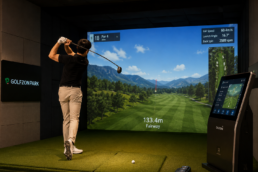
Some of it went indoors. Korea’s simulator sector has continued expanding while outdoor rounds shrink, and the reason is simple arithmetic: a screen golf session costs a small fraction of a green fee. We covered that market in depth in our look at Korea’s $1.6 billion screen golf empire, and the divergence between indoor and outdoor golf has only widened since.
Some of it left golf altogether. Younger golfers — particularly women in their twenties and thirties who entered the sport after 2021 — have moved toward running, tennis, and pilates. The economics are not subtle. A pair of running shoes and a park cost almost nothing, and Korea’s running boom has become a billion-dollar market partly by absorbing golf’s most price-sensitive converts.
Industry estimates now put Korea’s active golfing population near 6 million, with long-range forecasts pointing downward over the coming decade. Given the country’s demographics, that trajectory is difficult to argue with.
Who Still Plays, and What They Pay For
The golfers who stayed are not the golfers who arrived in 2021.
Broadly, three groups remain. The first is the core middle-aged base that played before the boom and will play after it. These golfers are relatively price-insensitive, hold memberships or long-standing club relationships, and book the premium morning tee times. Notably, that “golden hour” between 6:30 and 9 a.m. still absorbed 62.6% of all bookings in the first half of 2026 — roughly 29,805 groups. Demand at the top of the market did not soften much.
The second group is the value segment, and it is where all the growth is. These are the twilight players, the self-play groups, the two-somes booking two days out. They did not quit golf; instead, they rebuilt it around a lower price point. Athleisure brands are dressing them, regional courses are hosting them, and simulator bays are covering their winters.
The third group is the one that left. Younger recreational golfers who joined during lockdown treated the sport as a lifestyle purchase, and lifestyle purchases are the first thing dropped when the price stops feeling justified. Their departure explains the golf wear collapse far better than any fashion cycle does.
Course operators are still learning to price for a market with this shape. Meanwhile, the ones that keep optimizing exclusively for the morning premium slot are the same ones watching their afternoon tee sheets stay empty.
What the Korea Golf Industry Means If You Visit or Invest
For visitors, the practical picture has improved.
Green fees remain high by international standards, so plan accordingly. Nevertheless, the levers that Korean golfers discovered in 2026 are available to foreigners too. Twilight tee times are dramatically cheaper and far easier to book. Self-play rounds remove the caddie fee, though be aware that many premium courses still mandate a caddie. Two-player bookings are now widely accepted, which was rarely true five years ago.
Furthermore, geography is your friend. Courses in Chungcheong and Gangwon cost meaningfully less than metro-area equivalents, and the drive is often under two hours. If you want to see what the top of the market looks like, Top 100 Golf Courses maintains a ranked list of Korean courses worth reading before you book.
For investors, the calculus is harder but more interesting.
The bear case is straightforward. Population decline, a shrinking golfer base, oversupplied holes, compressed margins, and a frozen transaction market all point the same direction. Additionally, the tax subsidy that props up public course economics is politically vulnerable.
The bull case rests on scarcity and timing. Land near Seoul cannot be manufactured, and the courses that already occupy it hold a genuinely defensible position. Prices are falling but transactions are not clearing, which usually means buyers eventually get their number. Distressed member courses carrying large deposit obligations may become the first real bargains.
Global capital is watching, too. LIV Golf announced a multi-year return to Korea in 2026, anchored at Asiad Country Club in Busan. That commitment says something about Korea’s value as a golf audience even as its value as a golf real estate market gets repriced.
The Correction Is the Story
It would be easy to write this as a collapse narrative. That would be wrong.
Korea still runs 527 golf courses for 51 million people. It still sends more players to the LPGA than any country except the United States. It still supports a simulator industry that is exporting the format worldwide. By any absolute measure, the Korea golf industry remains enormous.
What ended was not golf. What ended was the pricing power that came from having a captive, bored, cash-rich population with closed borders. Once that condition lifted, the market began doing what markets do — testing whether ₩300,000 for eighteen holes was ever a real price or just a temporary one.
The answer, so far, appears to be temporary. Twilight rounds, three-player groups, self-play, and last-minute discounts are not signs of a dying sport. Rather, they are signs of consumers who finally regained leverage.
The courses that adapt to that reality will be fine. The ones still holding out for 2022 valuations are going to be on the market for a while.



Related Posts