

The $72 Billion Bet Hiding in Plain Sight
On May 27, 2026, the Korea AeroSpace Administration quietly celebrated its second anniversary in Sacheon. The small city sits 300 kilometers south of Seoul. Most foreign investors have never heard of it. There were no fireworks. Furthermore, there was no SpaceX-style livestream. However, behind the modest ceremony sits one of the most consequential industrial bets any middle power has placed this decade. The Korea deep space economy strategy commits roughly $72.6 billion of public capital through 2045. That year marks the 100th anniversary of Korea’s liberation from Japanese colonial rule.
For foreign investors watching Asia, this matters in ways that go well beyond rocket nostalgia. Specifically, Korea is now treating space the same way it once treated semiconductors, shipbuilding, and biopharma. The bet combines chaebol capital, government risk-sharing, and a 20-year horizon. As a result, the Korea deep space economy is no longer a science story. Instead, it has become a serious capital allocation theme. Hanwha Aerospace, Korea Aerospace Industries (KAI), Satrec Initiative, and LIG Nex1 anchor a deep supply chain. Notably, every name listed here already trades on the KOSPI or KOSDAQ.
The Korea Space Industry 2045 Numbers: $72.6B and 10% Global Share
The headline figure is straightforward but easy to misread. Specifically, the 100 trillion won commitment is a cumulative public-and-private spending envelope through 2045. It is not an annual budget. Furthermore, it sits inside a broader Korean Mars mission investment framework. That framework also covers civil satellites, launch services, and a national positioning-navigation-timing system.
The near-term acceleration is sharper. In particular, KASA’s 2027 budget target is 1.5 trillion won — about $1.14 billion. By comparison, the 2024 budget sat at 836.2 billion won. Moreover, the agency has set two explicit market goals. The first is lifting Korea’s share of the global space economy from about 1 percent today to 10 percent by 2045. Second on the list is the creation of roughly 250,000 new jobs across the aerospace value chain by the same year.
📊 [INFOGRAPHIC 1: Korea Space Budget Growth 2023–2045 — line chart showing annual budget ramp from ₩836B (2024) to ₩1.5T (2027) to cumulative ₩100T by 2045]
For context, the global space economy reached $626 billion in 2025, according to Novaspace’s Space Economy Report. Furthermore, the report projects expansion to $1.01 trillion by 2034 at a 12 percent compound annual growth rate. Capturing 10 percent of that market would put Korea on roughly equal footing with the European Space Agency’s current bloc. In short, it is a striking claim. Notably, Korea has launched fewer than ten satellites on its own rockets to date. However, the ambition is the point. Korea has built its industrial reputation on doing things the world doubted: chips ahead of Intel, batteries ahead of Panasonic, biosimilars ahead of Pfizer. The space economy is the next set piece in that pattern.
KASA’s Five-Mission Roadmap Through 2045
The path from a 2026 anniversary photo to a Mars flag is not a single megaproject. Instead, it is a sequence of five stacked missions, each de-risking the next.
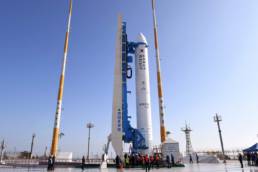
The 2026 calendar opens with the fifth launch of the Nuri rocket — KSLV-II — scheduled for June 2026. Specifically, it will carry five microsatellites and ten university-built CubeSats. After that, the sixth Nuri launch in 2027 will deploy 12 domestic satellites. Notably, the payload includes Korea’s first space-debris-removal demonstrator. Meanwhile, in 2029, KASA plans to send a lunar communications orbiter aboard the larger next-generation rocket, KSLV-III. This orbiter will enable far-side communications for future landers.
Then the schedule accelerates. KSLV-III’s first launch is scheduled for 2030. Furthermore, a lunar soft-landing verification probe is slated for 2031. Finally, the headline mission — Korea’s first indigenous lunar lander and rover — is targeted for 2032. KSLV-III will carry it on a 14-day surface mission. From 2028 onward, KASA Administrator Oh Tae-seog has committed to at least one Nuri launch per year, with a target of four annually.
The deeper-horizon goals are even more aggressive. By 2035, KSLV-III is supposed to transition to full first-stage reusability. As a result, Korea would move onto a Falcon-9-like cost curve. Moreover, KASA’s July 2025 long-term roadmap added a “lunar economic base” by 2045, alongside a new, larger lunar lander in 2040. KASA wants to develop homegrown lunar landing and roving technology. In addition, it aims to extract and exploit moon resources such as water ice. Critically, the 2045 Mars touchdown sits at the top of that pyramid — not as a stand-alone gamble, but as the logical capstone of fifteen years of stacked capability building.
The Contractors Driving the KASA Hanwha Lunar Plan
To understand the KASA Hanwha lunar plan, follow the prime contracts. In March 2024, Hanwha Aerospace was selected as the lead operator for KSLV-III. Notably, the win came after KAI withdrew from the bidding. Specifically, the contract value sits at 2.132 trillion won — roughly $1.5 billion — running through 2032. In addition, Hanwha Aerospace signed a 103 billion won agreement with the Korea Aerospace Research Institute (KARI) in December 2025. That deal covers the propulsion system for the 2032 lunar lander itself.
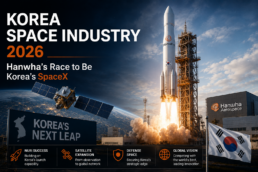
The Hanwha consolidation play has gone further. In March 2026, Hanwha Aerospace and Hanwha Systems together acquired a 4.99 percent stake in KAI for approximately 930 billion won. As a result, industry observers immediately read the move as the opening of a vertical-integration playbook. Many local outlets described it as a serious attempt at building a “Korean SpaceX.” For broader context, Seoulz has covered Hanwha’s strategic posture in its Korea defense industry 2026 analysis. In addition, the Korea space industry 2026 profile of Hanwha’s race to be Korea’s SpaceX traces the launch-vehicle side in more detail.
The wider supply chain matters just as much. Satrec Initiative — already 36.31 percent owned by Hanwha Aerospace — supplies the small-satellite buses that fly on most Korean missions. Furthermore, Hanwha Systems builds defense reconnaissance payloads and synthetic-aperture radar instruments. Meanwhile, LIG Nex1 contributes guidance and control systems. Intellian Technologies supplies satellite antennas for ground stations. KAI itself remains Korea’s largest aerospace manufacturer and the builder of the KF-21 fighter jet. Together, these companies form the backbone of the Korea space industry 2045 ecosystem.
Inside the Korea Deep Space Economy’s 2032 Lunar Lander
The flagship near-term project sits inside Phase 2 of the Korean Lunar Exploration Program. Specifically, the total program cost is 530.3 billion won — roughly $390 million. The budget is spread across ten years from October 2024 through December 2033. By comparison, NASA’s Artemis Human Landing System contracts run into the billions of dollars per provider. As a result, Korea is attempting a lunar landing at roughly one-tenth the cost.
The mission architecture is conservative on purpose. Specifically, the 1.8-ton lander is designed for a 14-day surface mission near the lunar equator or south pole. Moreover, KASA aims to complete the preliminary design by 2027. The detailed design follows by 2029, with launch in 2032 aboard KSLV-III. The payload mix will include instruments for surface resource analysis, in-situ extraction tests, and the rover itself.
One of the most underappreciated angles sits underground in Gangwon Province. Lee Pyeong-koo, president of KIGAM, framed the connection during a 2025 site visit. He said: “I find it profoundly gratifying that at the very place where we once mined the coal that fueled our nation’s economic growth, we are now embarking on research to bring helium-3 from the moon to Earth.” The Korea Institute of Geoscience and Mineral Resources has converted an abandoned coal mine into a moon-environment simulation laboratory. Researchers there prototype the regolith-handling and extraction systems that may eventually fly on lunar landers. Few foreign analysts have picked up on this transition. However, it captures the Korean industrial pattern perfectly — repurposing dying heavy industries to feed the next-generation export economy. Seoulz has examined the same pattern in its Korea nuclear strategy 2026 coverage. Shipyards and reactors moved in lockstep with national policy then, too.
Why the 2045 Mars Goal Anchors the Korea Deep Space Economy
The Mars 2045 target is the most-quoted line of the entire program. However, it is also the most misread. The date is not arbitrary. Specifically, 2045 marks the centennial of Korea’s liberation from 35 years of Japanese colonial occupation. Planting a flag on Mars in that year is, in plain terms, a national-identity statement. It sits on the same emotional register as the 1988 Seoul Olympics or the 2002 World Cup co-hosting.
That said, the symbolism is downstream of a harder business case. By 2045, the global space economy is projected to be a multi-trillion-dollar industry. Capturing 10 percent of that market — KASA’s stated target — translates to roughly $100 to $130 billion in annual Korean space revenue. Furthermore, a successful Mars mission would put Korea among only a handful of countries with demonstrated deep-space capability. As a result, the bargaining position of Hanwha and KAI on international contracts improves directly. In other words, the Mars flag is a marketing instrument for the entire Korean defense and aerospace export apparatus. The Korean Mars mission investment thesis is, at its core, about pricing power.
Sacheon as Korea’s “Toulouse of Asia”
The geography of the bet is as deliberate as the budget. KASA’s headquarters sit in Sacheon, a southern city better known historically for textile mills. However, the choice is not accidental. KAI’s main facility is already there. Furthermore, the regional cluster is being built around it in three layers — Sacheon for satellites, Goheung for launch vehicles, and Daejeon for R&D.
The cluster strategy commits 380.8 billion won — about $290 million — between 2024 and 2030. It funds satellite manufacturing, research and development, and launch facilities. According to a recent Carnegie Endowment analysis, Korea currently occupies the third tier of space-capable nations. As such, its aspiration to rank among the world’s top-five space powers by 2045 represents an ambitious industrial policy challenge. The cluster is the policy response.
Then-President Yoon Suk Yeol explicitly framed Sacheon as the “Toulouse of Asia.” It was a deliberate reference to the southern French city that hosts Airbus and serves as Europe’s de facto space capital. Moreover, a new launch pad and assembly facility for commercial-purpose rockets is being built on a 24,000-square-meter plot in Goheung. Environmental testing facilities for satellites are also being established in Jinju. As a result, the supply chain is being physically anchored in a single region. Notably, Samsung built its memory empire around Giheung and Hwaseong the same way. The pattern is familiar to anyone who has read Seoulz’s Korea scale-ups 2026 analysis — capital, policy, and geography moving as one piece.
International Partnerships as a Capability Multiplier
Korea cannot build the Korean Mars mission investment thesis in isolation. Crucially, it does not have to. In May 2021, Korea became the tenth signatory of the Artemis Accords. It joined Australia, Canada, Italy, Japan, Luxembourg, the United Kingdom, the United Arab Emirates, Ukraine, and the United States. Furthermore, in October 2024, KASA signed a Moon-to-Mars study agreement with NASA. As a result, it became the fifth nation to formalize that kind of agreement.
The European partnership followed in September 2025. Specifically, KASA and the European Space Agency signed a Memorandum of Understanding at the International Astronautical Congress in Sydney. The two agencies committed to cooperation on space weather monitoring and shared satellite communications facilities. Meanwhile, KASA Administrator Oh Tae-seog traveled to the United States in May 2026 immediately following the CAS500-2 launch by SpaceX. During the trip, he held back-to-back meetings with SpaceX, Umbra Space, and Rocket Lab. Discussion topics included reusable launch technology, synthetic-aperture radar payloads, and joint payload manifesting.
The diplomatic strategy is best understood as capability arbitrage. Korea pays for cutting-edge launches it cannot yet deliver domestically. In return, it acquires schedule certainty, integration experience, and a foreign-policy credit balance with Washington and Brussels. That balance has already paid off in adjacent industries — most notably in the nuclear and shipbuilding sectors. As such, the pattern is the same playbook Korea has used for decades.
The KOSPI Stocks Behind the Korea Deep Space Economy
For foreign investors, the Korea deep space economy thesis is increasingly tradable on public markets. Hanwha Aerospace (KRX: 012450) sits at the center of the trade. Specifically, the company reported revenue of 26.61 trillion won — roughly $18.2 billion — in 2025. Operating profit came in at 3.03 trillion won. Furthermore, both figures grew sharply on the back of K9 howitzer and K2 tank exports to Poland. As a result, Hanwha Aerospace can fund its long-horizon space program out of operating cash flow rather than dilutive equity rounds. The stock reached an all-time high of 1,655,000 won on March 4, 2026. At that price, the company carries a market capitalization above 67 trillion won — roughly $46 billion.
📊 [INFOGRAPHIC 2: Korea Space Industry Ecosystem Map — Hanwha Aerospace at center, with arrows to Satrec (36.31%), Hanwha Systems, KAI stake (4.99%), and key suppliers LIG Nex1, Intellian, HVM]
KAI (KRX: 047810) is the second pillar. Specifically, it dominates Korean fixed-wing aircraft manufacturing and increasingly competes for satellite-system-integration work. Meanwhile, Satrec Initiative (KRX: 099320) is Korea’s leading small-satellite manufacturer. It sits inside the Hanwha orbit but trades as a pure-play on Earth-observation hardware. Furthermore, LIG Nex1 contributes defense-grade guidance and control systems. Intellian Technologies, listed on the KOSDAQ, supplies satellite antennas used by maritime, government, and commercial customers worldwide. HVM rounds out the cluster with specialty alloys.
For investors who prefer baskets, two ETFs dominate the trade. Specifically, the TIGER K Defense & Space ETF returned 176.9 percent in the twelve months through January 2026. Hanwha Aerospace was its largest holding. Meanwhile, the PLUS Space & UAM ETF — which includes Satrec Initiative and KAI — returned 122.8 percent over the same window. “If the SpaceX IPO succeeds, the current valuations of Korean aerospace companies will be justified,” said Kum Jung-sub, head of the ETF business division at Hanwha Asset Management. Notably, the SpaceX IPO is currently expected in mid-2026 at a reported $1.5 trillion valuation. It has become the global re-rating event the Korean trade is positioned for.
The Reality Gap: Korea vs SpaceX, Blue Origin, ISRO
A clear-eyed view of the Korea deep space economy also has to account for the gap. Specifically, the United States accounts for roughly 55 percent of the global space economy — about $259 billion in 2026. SpaceX’s commercial leadership drives most of that share. In addition, U.S. government space spending runs roughly $77 billion annually across NASA and national-security programs. China sits at roughly 8 percent at $38 billion, with at least $19.9 billion in disclosed government outlays. Europe holds about 18 percent. Korea, by contrast, is starting from approximately 1 percent.
The technical gap is equally stark. KSLV-III is designed to carry roughly six times the payload of Nuri to low Earth orbit. However, even with that improvement, the rocket will be smaller than Falcon 9. Moreover, it will be significantly smaller than China’s Long March 5. Furthermore, India landed a spacecraft on the lunar surface in August 2023 with Chandrayaan-3. As a result, India became the fourth country to do so. Japan followed in January 2024. Consequently, Korea would become at best the seventh or eighth country to soft-land on the moon, well behind its main Asian peers.
The Korean rebuttal is twofold. First, the country is operating with a far smaller absolute budget than its competitors. As such, it is optimizing for capital efficiency rather than first-mover advantage. Second, the KASA Hanwha lunar plan explicitly targets reusable launch capability by 2035. As a result, Korea’s cost-per-kilogram disadvantage would compress faster than incumbent peers can respond. Whether this can actually be executed mid-program is the central technical risk of the entire bet.
What the Korea Deep Space Economy Needs to Get Right by 2032
Several variables will determine whether the Korea deep space economy delivers on its 2045 target.
First, the Nuri rocket needs to achieve a success rate above 90 percent. Notably, the fourth Nuri flight succeeded as the first private-led night launch in Korean history. As a result, the June 2026 fifth launch becomes the next critical test. Second, the KSLV-III reusability pivot — approved by the National Space Committee in February 2025 — must be executed without slipping the 2030 first-flight target. Third, the private-sector ecosystem needs depth beyond Hanwha. Specifically, startups like Innospace and Perigee Aerospace need to graduate from suborbital test flights to small-orbital launches before 2028.
Fourth, political continuity matters more than usual. Specifically, the roadmap was conceived under former President Yoon Suk Yeol. Meanwhile, the Lee Jae Myung administration took office in June 2025. So far, the new government has preserved the framework. It also signed off on the second K2 tank deal with Poland under the same defense-industry banner. However, twenty years is a long time for any program to outlast multiple electoral cycles.
📊 [INFOGRAPHIC 3: Top 5 Space Power Ranking — current global market share by country (US 55%, Europe 18%, China 8%, Korea 1%) vs Korea 2045 target (10%)]
For foreign investors, the practical takeaway is concrete. The Korean Mars mission investment is no longer a future story. Rather, it is being built into earnings statements, ETF returns, and supply-chain integration deals right now. The base case is asymmetric. Specifically, if Korea hits even half of its 2045 targets, the market-cap re-rating across the KOSPI space cluster looks similar to what happened to Korean shipbuilding and biopharma in earlier decades. If Korea misses, the defense-export business continues to support Hanwha Aerospace’s cash flow regardless.
📊 [INFOGRAPHIC 4: Korea Space Mission Timeline 2024–2045 — chronological roadmap from KASA launch through Nuri 5/6, KSLV-III first flight (2030), lunar lander (2032), reusable rocket (2035), lunar economic base + Mars touchdown (2045)]
The Pattern Korea Always Falls Back On
Step back from the rockets, the lunar landers, and the Mars timeline. Notably, the Korea deep space economy looks remarkably similar to every previous Korean industrial bet. First, the state picks a long-term technology frontier. Then, it funnels chaebol capital into national-champion contractors. Finally, it builds a regional cluster around the supply chain and lets international partnerships absorb the early-stage risk.
That formula built Samsung Electronics, LG Energy Solution, HD Hyundai Heavy Industries, and Celltrion. The question now is whether the same playbook can produce a Korean SpaceX in the next two decades. Crucially, the answer to that question is what foreign investors are really pricing. They price it when they buy Hanwha Aerospace at 67 trillion won. They price it when they bid up the TIGER K Defense & Space ETF to a 176.9 percent annual return.
The 2045 Mars flag is the headline. However, the real story is the industrial machine being built underneath it.