South Korea unveils revised plan for unified military academy
Defense Ministry proposes a network of campuses with a central headquarters in Daejeon, starting with the 2029 freshman class.
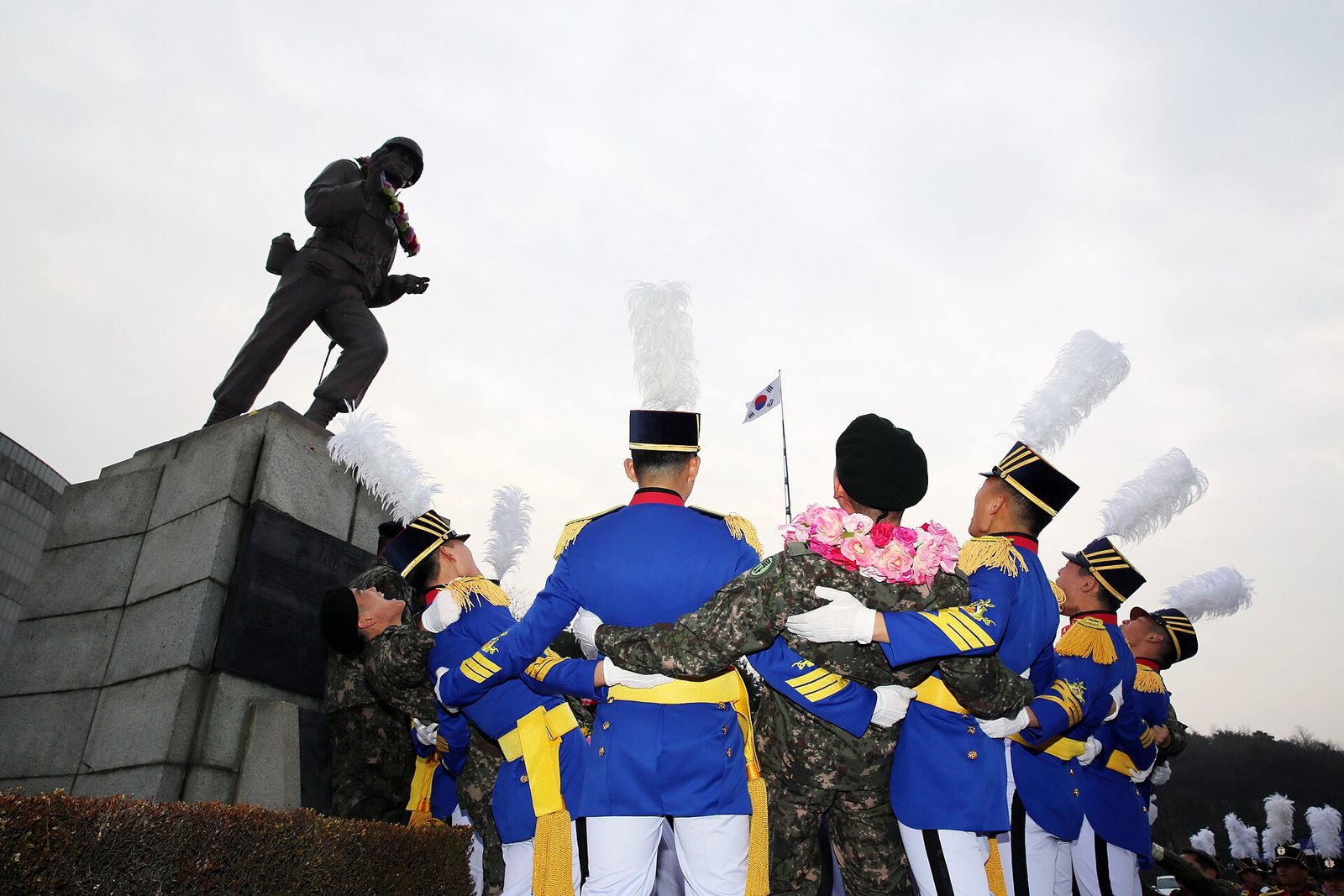
Defense Minister Kang Shin-chul presented a revised plan for the establishment of a unified Korea Armed Forces Academy during a ruling party-government consultation on Nov. 18, the Ministry of National Defense said.
The consultation was jointly led by Kang, Democratic Party Policy Committee Chairman Kwon Chil-seung and National Assembly National Defense Committee Chairman Jin Seong-jun.
Kang said the creation of the academy is an important matter that opens a new future for South Korea's defense education, and that the direction should be clear and bold while the implementation process should be thorough and prudent, according to the ministry.
The revised plan was prepared after collecting opinions from the National Assembly, military leadership, officials and cadets of each service academy, reservists and civilian experts, building on the basic plan announced in July.
Kang said the goal of the academy is to train elite officers who are loyal to the Constitution and the people and who will lead victory in future warfare based on advanced science and technology and a deep understanding of human beings.
To achieve this, the ministry will increase educational autonomy and diversity based on the characteristics of each service, and pursue innovation in the education system centered on strengthening future warfare response capabilities and internalizing constitutional values.
The ministry plans to organize the academy as a network with an integrated headquarters and graduate school for joint education, and regional campuses for each service's education, to strengthen both service-specific characteristics and joint capabilities.
The education system will be reorganized so that cadets study together in their first year right after admission and in their fourth year right before graduation, while second- and third-year education and summer military training will remain led by each service.
The ministry will establish master's and doctoral graduate programs in science and technology and strategy fields for future warfare at the academy to strengthen faculty education and research capabilities and improve the quality of cadet education.
It will gradually expand education capacity to provide opportunities for advanced education such as graduate school to officers from various commissioning sources including ROTC, Officer Candidate School and the Army Third Military Academy.
The ministry will appoint the best education expert as the academy superintendent, with a basic term of two years and one possible reappointment for up to four years, to pursue a mid- to long-term education vision without wavering.
For civilian faculty, existing military civilian professors will be converted to special career civil servants and new professors will be recruited. Active-duty professors will also have improved research conditions and treatment.
The academy will be converted from belonging to each service to a direct agency of the Ministry of National Defense. The ministry will take responsibility for budget and institutions, and closely consult with the Ministry of Education and other related ministries.
The integrated headquarters and graduate school will be established at Jaundae in Daejeon, where excellent universities and research institutions are concentrated, to increase synergy in education and research.
The Army regional campus will be relocated to the Chungcheong region, considering educational conditions such as educational connectivity with the integrated headquarters and the Air Force regional campus, and the relocation of administrative agencies.
The Navy regional campus and Air Force regional campus will remain in Jinhae and Cheongju, respectively, to sufficiently guarantee educational conditions considering each service's characteristics.
Educational infrastructure at all schools will be invested in and modernized in stages to create a smart campus environment suitable for future warfare education.
To avoid confusion for applicants and parents, cadet selection will continue to be conducted by each service as now, and the new education system will apply to freshmen entering in the 2029 academic year.
The ministry will also separately select Marine Corps cadets and review the establishment of a Marine Corps military education system to support the transition to a quasi-four-service system.
Kang expressed his will to foster creative talents who ask future security questions beyond the existing education framework, and emphasized that Army, Navy and Air Force cadets will sweat together and unite as one warrior community to become the main players of the armed forces who win on any battlefield.
The ministry will continue to listen to opinions from various sectors and finalize measures to foster active and creative elite officers who can respond to future security challenges.