KAI Marks 27th Anniversary, Targets Global Top 4 Aerospace Platform by 2040
CEO Kim Jong-chul outlines six future core businesses spanning civil aviation, next-generation military platforms and space solutions.
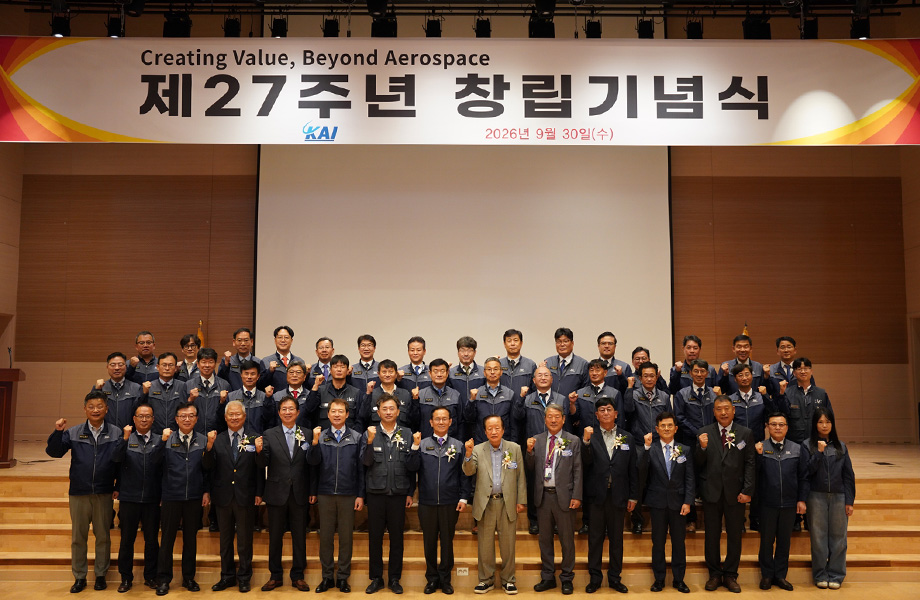
Korea Aerospace Industries (KAI) held its 27th anniversary ceremony at its Sacheon headquarters on Sept. 30, with President Kim Jong-chul presenting a long-term vision to become a global top-four aerospace platform company by 2040.
The event was attended by employees and retired executives, who reviewed achievements over the past 27 years and shared the company's future vision. Long-service employees were also recognized, with Kim expressing gratitude to all staff for the company's growth.
In his address, Kim said KAI will transform itself into a "global first-class advanced platform company" spanning military, civil, future mobility, manned-unmanned complex systems and space, according to a company release.
As key tasks for realizing the vision, Kim emphasized quality completeness and expansion into the civil sector. He cited the perfect delivery of the KF-21 Boramae fighter, which has entered full-scale mass production, and preventive quality assurance for the Mirion multi-purpose unmanned aerial vehicle as ways to solidify customer trust. He also outlined plans to expand the business structure into the civil sector through international joint development of next-generation civil aircraft and independent development of a civil-military dual-use AAV.
Kim also stressed building a sustainable win-win cycle through shared growth with partner companies, so that KAI's growth leads to the development of South Korea's aerospace industry.
He pledged to secure a super-gap competitive edge by eliminating unnecessary procedures, establishing a data- and AI-based rapid decision-making organization, redesigning field-centered authority and responsibility, and fostering a culture that does not fear failure.
Since its founding in 1999, KAI has led the development of South Korea's aerospace industry with aircraft including the KT-1 basic trainer, T-50 supersonic trainer, Surion utility helicopter, Mirion and KF-21. The company plans to continue its growth centered on six future core businesses under three pillars: civil and future mobility (next-generation civil aircraft, future airframe AAV), next-generation military platforms (AI manned-unmanned complex systems, sixth-generation fighter, next-generation high-speed medium maneuver helicopter), and space solutions (space-based infrastructure and services).
For the civil sector, KAI will accelerate market entry through global partnerships. In the military sector, it will combine AI technology to advance next-generation platforms. In the space sector, it will pursue internalization of core payloads, satellite network construction and entry into service businesses, the company said.