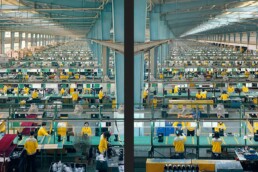


Walk onto a factory floor in South Korea, and you will see the country’s industrial might in motion. Robotic arms, moving with precision, weld car bodies, assemble electronics, and package goods. Automation is the backbone of Korean manufacturing. However, a growing number of these tireless workers are imported at prices that local producers argue are unfairly low. In response, Seoul is now drawing a line in the sand.
The Korea Trade Commission (KTC), an agency under the Ministry of Trade, Industry and Energy that investigates unfair trade practices, has finalized its decision to recommend significant anti-dumping tariffs on industrial robots from Japan and China. The move follows a year-long investigation initiated by a petition from HD Hyundai Robotics, a major domestic player. The investigation concluded that these imported robots were being “dumped”—sold in Korea at prices below their fair market value—causing material injury to the local industry. As a result, these new Korean robot tariffs are set to rebalance the market.
The Details of the New Industrial Robot Duties
The tariffs are specific and targeted. For Japanese exporters, the rates are set at 17.45% for FANUC Corporation and 18.64% for YASKAWA Electric Corporation, with other suppliers facing a rate of 18.08%. Meanwhile, Chinese producers will see tariffs ranging from 15.96% to 19.85%, affecting major names like KUKA Robotics, Kawasaki Heavy Industries, and ABB Engineering’s Shanghai unit. This is a direct intervention to correct what the KTC views as unfair competition.
The products in question are the workhorses of modern automation: vertical articulated robots with four or more axes and a payload capacity between 6 and 600 kilograms. These are not small, specialized machines but the core robotic systems used for welding, assembly, and logistics across Korea’s key export industries. For investors and supply chain managers, this decision is a critical development. It will likely increase the cost of factory automation for companies reliant on Japanese and Chinese imports, therefore potentially shifting demand toward domestic manufacturers like HD Hyundai Robotics. The move is designed to shield Korea’s industrial foundation from price erosion.
A Pattern of Protection
This action on robotics is not an isolated event. Furthermore, the KTC’s recent agenda reveals a broader, more assertive stance on trade defense. The commission also announced it is launching a review of existing duties on Chinese Polyethylene Terephthalate (PET), a material used in bottles and packaging, following requests from domestic firms to increase the tariff rate. In addition, investigations are underway into patent infringements related to electric vehicle batteries and potential dumping of PVC paste resin from several European nations.
This pattern of Korea anti-dumping measures signals a strategic shift. Seoul is demonstrating its willingness to use trade remedies to protect what it considers strategic domestic industries from global market pressures. For international businesses exporting to Korea, the takeaway is clear: the risk of facing a trade investigation is rising, particularly in sectors central to the nation’s economic future. The message from Seoul is that market access comes with an expectation of fair play.