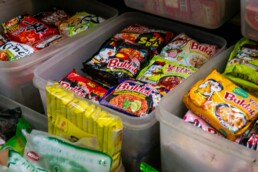


Picture a teenager in Ohio filming herself with a bright red bowl of noodles. She takes one bite, gasps, and reaches for a glass of milk. Now multiply that clip by a few million, across a decade and more than 90 countries. That, in short, is how a spicy chicken noodle from a struggling Korean food company became one of the country’s most profitable exports.
Korean ramyeon exports reached a record $1.52 billion in 2025, up 21.8% from the year before, according to Korea Customs Service data reported by Korea JoongAng Daily. It was the 11th straight year of growth. Then 2026 got even hotter. In the first half alone, shipments hit about $940 million, up 27.9%. As a result, the industry is now openly talking about a $2 billion year.
We have covered the wider food story before, in our look at the K-food global market. This article goes one level deeper. Specifically, it asks how a cheap packet of noodles produces software-like profit margins, why the weak won matters so much, and what could still go wrong. For investors, it is a rare consumer story with real numbers behind the hype. For everyone else, it explains why your local supermarket suddenly has a whole aisle of Korean noodles.

Korean Ramyeon Exports by the Numbers: From $1.5 Billion to a $2 Billion Target
First, some context. Instant noodles are not new to Korea. Samyang Foods made the country’s first instant ramyeon in 1963, and Koreans still eat more instant noodles per person than almost anyone. For decades, however, the industry was a domestic business. Exports were a side line, mostly shipped to Korean communities abroad.
That changed in the mid-2010s. Since 2014, Korean ramyeon exports have grown every single year. Over the past five years, growth averaged about 23% annually. In practical terms, the export line crossed $1 billion in 2024 and $1.5 billion in 2025. Meanwhile, the first half of 2026 was the strongest six months on record.
The half-year curve tells the story well. In the first half of 2022, exports were about $300 million. By the same period of 2025, they had passed $700 million. In the first half of 2026, as Asia Economy reported, they reached $935 million. That is roughly a tripling in four years.
Why does the $2 billion figure keep appearing? The math is simple. If the second half of 2026 merely matches the first half, exports land near $1.9 billion. Historically, however, the second half is stronger, thanks to holiday demand in the West and year-end promotions in Asia. Consequently, industry groups and Korean media now treat $2 billion as a realistic target rather than a slogan.
Ramyeon is also carrying the wider food sector. In the first half of 2026, it was the largest single category among Korea’s processed food exports. For context on the broader numbers, see our earlier report on K-food exports. In other words, when Seoul celebrates record food exports, it is largely celebrating noodles.
Where Buldak Noodles Go: China, America and the New Frontier
So who is buying? The 2025 country data gives a clear map.
China was the largest market by far, at $385.4 million, up 47.9%. The United States came second at $254.7 million, up 18.2%. Southeast Asia followed at $223.2 million. Next came Central Asia at $82.4 million, Japan at $77.3 million and the Middle East at $47.5 million. Notably, Central Asia grew 38.7% and the Middle East 22%, both faster than the overall market.

Each market buys Korean noodles for a different reason. In China, Buldak noodles are sold increasingly through discount snack chains, a fast-growing channel that sells packaged snacks at low prices. In the US, by contrast, the growth has come from mainstream retail. Buldak is no longer confined to Korean grocery stores. Instead, it sits on the shelves of Walmart and Costco, right next to Maruchan and Nissin.
Europe is the newest growth engine. In the second quarter of 2026, Samyang’s European sales jumped 61%, led by Germany and France. Moreover, the Middle East and Central Asia are becoming meaningful markets. In Muslim-majority countries, halal certification matters, and many Buldak lines carry it. In Kazakhstan and Uzbekistan, meanwhile, Korean food benefits from a long-established Korean diaspora and strong K-drama viewership.
Pop culture keeps pouring fuel on the fire. In 2025, Netflix’s animated hit KPop Demon Hunters showed its heroines slurping cup noodles, and searches for Korean ramyeon spiked worldwide. We explored that film’s impact in our piece on Korea’s animation industry. For Korean ramyeon exports, it was free global advertising at exactly the right moment.
The Accidental Origin of Buldak Noodles
To understand the K-ramyeon boom, you need to meet one product. Buldak Bokkeum Myeon, or “fire chicken stir-fried noodles,” launched in April 2012.
Its origin is almost a business-school case. In 2010, Kim Jung-soo, then working at Samyang, ate lunch at a spicy chicken restaurant in central Seoul. The dish was brutally hot. Yet customers kept coming back, sweating and fanning their mouths, as the Buldak Ramen entry on Wikipedia describes it. Kim saw a product idea in that mix of pleasure and pain. She then pushed food scientists to make the prototype hotter, not milder.
Development was expensive for a company that could not afford failure. The team reportedly used about two tons of sauce and 1,200 chickens to get the flavor right. At the time, Samyang was a fading brand. It had pioneered Korean ramyeon, but it had lost its leadership to Nongshim decades earlier, after a damaging food-safety scandal in 1989. Therefore, Buldak was a bet the company needed to win.
At first, the launch was modest. The real break came in 2014, from YouTube. The British duo behind the Korean Englishman channel challenged friends to eat the noodles without drinking water. Almost overnight, the “Fire Noodle Challenge” went viral. Soon, thousands of creators around the world were filming their own attempts. In effect, Samyang received years of global marketing for free, and the seeds of today’s Korean ramyeon exports were planted.
Samyang then did something clever. Rather than rely on one flavor, it built a family. Today, Buldak noodles come in carbonara, cheese, rosé, habanero lime, jjajang and many more versions. The carbonara variety, in particular, became a hit with consumers who wanted the brand but not the full burn. Furthermore, the brand now stretches into sauces, snacks and tteokbokki. By May 2026, cumulative Buldak sales had passed 10 billion units.
Inside Samyang Foods’ 23% Margin
Now for the part that makes investors sit up. Instant noodles are usually a low-margin business. Yet Korean ramyeon exports have become a high-margin one. Samyang Foods is not a usual noodle company.
In the second quarter of 2026, Samyang posted revenue of 770.3 billion won, up 39.3%. Operating profit rose 46.7% to 176.2 billion won. That works out to an operating margin of about 23%, according to Asia Economy’s earnings report. It was the sixth consecutive quarter above 20%. For comparison, Nongshim’s margin in the same quarter was around 6%.

How is that possible? Four factors stand out.
Overseas prices are higher. A pack of Buldak costs far more in a US supermarket than in a Seoul convenience store. As a result, every export unit earns more than a domestic one. In the second quarter, overseas sales reached 645.8 billion won, or about 84% of total revenue. By contrast, the export share was 69% as recently as 2023.
The won is weak. Samyang makes almost everything in Korea and sells most of it abroad. Therefore, its costs are in won, while much of its revenue is in dollars, yuan and euros. In mid-2026, the won weakened past 1,550 per dollar, its weakest level in roughly 28 years. For a heavy exporter, that is a direct profit boost. We tracked those currency swings in detail earlier this year.
One brand, huge scale. Buldak dominates Samyang’s sales. Because of that, the company can run long, efficient production runs on a narrow range of products. Its Miryang plants were built specifically for export, with smart-factory automation and robots. In other words, each extra pack costs little to make.
Pricing power. Few food companies can raise prices without losing customers. Samyang did it in the US in late 2025, as we explain below, and demand held. That is the clearest sign of a genuine brand rather than a commodity.
The regional numbers show how broad the growth is. In the second quarter of 2026, Americas sales rose 54% to 203.6 billion won. China rose 44% to 181 billion won. Europe climbed 61% to 80.6 billion won. For the first half, Samyang’s revenue totaled nearly 1.49 trillion won, with operating profit of 353.3 billion won.
Nongshim vs. Samyang: Two Strategies for the K-Ramyeon Boom
Of course, Samyang is not alone. Nongshim, maker of Shin Ramyun, is still Korea’s largest noodle company by revenue. Its approach to Korean ramyeon exports, however, looks very different.
Nongshim is the older globalizer. It opened a US factory in California in 2005 and added a second US plant in 2022. It also produces in China. Consequently, much of its overseas revenue is made abroad rather than exported from Korea. That model protects Nongshim from tariffs and shipping costs. On the other hand, it means the weak won helps Nongshim less than it helps Samyang.
The numbers reflect that difference. In the second quarter of 2026, Nongshim’s revenue was 956.1 billion won, larger than Samyang’s. Yet its operating profit was only 59.3 billion won. Its overseas sales grew a healthy 31% to 328.6 billion won. Even so, overseas business made up only about a third of its total. Nongshim is also building a dedicated export plant in Busan to serve new markets directly from Korea.
Ottogi, the third major player, is further behind. Its overseas share was only about 11.5% in early 2026. Still, it has set a goal of 1.1 trillion won in global sales by 2030.
The contrast is instructive. Samyang is a focused brand play with high margins and high currency exposure. Nongshim, meanwhile, is a diversified food company with a steadier profile. For readers who follow Korean stocks, the gap in valuations between the two tells you which story the market prefers right now.
The Capacity Race: Factories Behind Korean Ramyeon Exports
A brand is only as big as its factories. For several years, Samyang could not make Buldak fast enough. Stores in the US and Europe regularly ran out of popular flavors.
The company has responded with a building spree. In June 2025, it opened its second plant in Miryang, South Gyeongsang Province. That plant alone adds about 830 million packs a year, according to Korea JoongAng Daily. As a result, total Buldak capacity rose to about 2.8 billion packs annually.
Next comes China. Samyang is building its first overseas factory in Jiaxing, Zhejiang Province, with an investment of about 201 billion won. The plant is designed to make 840 million packs a year and is scheduled for completion in January 2027, as The Korea Times reported. Once it runs, total capacity should reach roughly 3.5 billion packs.
The China plant matters for two reasons. First, it serves Samyang’s largest market from inside that market. Second, it reduces the risk of relying entirely on Korean factories. However, it also means that some future revenue will no longer count as Korean ramyeon exports. That is a subtle point for anyone tracking customs data.
Five Risks That Could Cool the K-Ramyeon Boom
No boom lasts forever, and Korean ramyeon exports have clear pressure points. Here are the five that analysts watch most closely.
1. Tariffs. In 2025, the US imposed a 10% baseline tariff on Korean goods in April, raised to 15% in August. Samyang responded by lifting supply prices to US distributors by about 9% in October. On Walmart’s shelves, a five-pack of Buldak rose from $6.88 to $7.84, a jump of roughly 14%, according to The Korea Herald. So far, demand has absorbed the increase. Still, further trade tension could test that loyalty.
2. The currency tailwind could reverse. A weak won has flattered profits. If the won strengthens sharply, margins would fall even if sales keep rising. Investors should therefore separate real volume growth from currency gains.
3. Copycats. Success invites imitation. Fake or look-alike Buldak products have appeared in China, Southeast Asia, the US, Europe, the Middle East and Africa. Samyang holds trademarks in 88 countries but is fighting disputes in 27, as The Korea Times reported. In fact, a 2008 Korean court ruling had found the Korean word “buldak” too generic to protect. That is why the company is now registering the English name.
4. Regulators and spice limits. In June 2024, Denmark recalled three Buldak products over concerns that their capsaicin levels could be harmful. After testing, it lifted the recall for two of them, but kept the ban on the 3x Spicy version, as NBC News reported. The episode ended mostly well for Samyang. Nonetheless, it showed that extreme heat can attract regulators as well as fans.
5. Fad risk. Finally, there is the oldest question in consumer goods. Is this a durable brand or a trend? Bulls point to 14 years of growth and the shift into mainstream supermarkets. Bears point out that a single product line drives most of the profit. Either way, concentration cuts both ways.
What Investors Should Watch in Korean Ramyeon Exports
For foreign investors, the K-ramyeon boom is one of the cleaner ways to buy into Korean soft power. Unlike entertainment stocks, noodle makers report hard numbers every quarter. Moreover, the monthly customs data gives an early read on demand before earnings arrive.
Valuations remain a live debate. In mid-2025, a Bloomberg columnist noted that Samyang’s market value had grown to roughly equal that of Japan’s Nissin and Korea’s Nongshim combined. Since then, earnings have caught up with the price. In August 2026, DS Investment & Securities named Samyang Foods its top pick, with a target price of 1.9 million won. By its estimate, Samyang trades at about 14 times 2027 earnings. Nissin, by comparison, trades around 17 times, and Toyo Suisan around 15 times, according to Asia Economy.
Here is a practical checklist for following the story:
- Monthly customs data. Korea publishes ramyeon export figures every month. A slowdown there would show up long before quarterly results.
- Overseas share of revenue. For Samyang, watch whether the 84% share keeps rising or plateaus.
- Margins versus currency. If margins fall while the won strengthens, that is currency noise. If margins fall while the won is stable, that is a warning.
- China plant ramp-up. The Jiaxing launch in 2027 is the next big operational test.
- New flavors and categories. Sauces, snacks and frozen foods show whether Buldak can become a platform, not just a product.
Many Korean retail investors have poured money into US tech stocks, as we covered in our report on Korea’s US stock investors. Ironically, one of the best-performing consumer stories of recent years was sitting in their own convenience stores the whole time.
A Shopper’s Guide: How to Pick K-Ramyeon Abroad
Finally, a practical note for readers who simply want to eat the stuff. Thanks to the surge in Korean ramyeon exports, the noodle aisle abroad can be overwhelming. So here is a quick orientation.
Start with the heat scale. The original Buldak is rated at about 4,400 Scoville heat units. That is hot, but manageable for most spice fans. The 2x and 3x Spicy versions are far stronger. If you are new, try carbonara or cheese Buldak first, because dairy softens the burn.
Try the classics, too. Shin Ramyun is the benchmark Korean soup noodle, spicy but savory. Nongshim’s Chapaghetti, a black bean noodle, became famous abroad after the film Parasite. Ottogi’s Jin Ramen is a milder, budget-friendly favorite in Korea.
Check the label. Export versions sometimes differ slightly from Korean versions, especially for halal or local ingredient rules. If you want the authentic Korean recipe, look for Korean text on the back of the pack. Also, be wary of lookalike packaging at unusually low prices.
Eat it the Korean way. In Korea, many people eat instant noodles at a convenience store table, often with a triangle kimbap and a boiled egg. Some even visit dedicated self-cooking noodle shops, which we explored in our story on the ramyeon shop economy. For the full experience, add a slice of cheese and a handful of kimchi.
The Bottom Line on Korean Ramyeon Exports
A decade ago, Korean instant noodles were a cheap staple for students and soldiers. Today, they are one of Korea’s most profitable consumer exports. Korean ramyeon exports have grown for 11 years straight, and 2026 looks likely to set yet another record, possibly above $2 billion.
The engine of that boom is unusually concentrated. One product, Buldak noodles, turned a fading company into a high-margin global brand. Samyang Foods now earns about 84% of its revenue abroad and posts margins most food companies can only dream about. Meanwhile, Nongshim is betting on a broader, steadier model with factories closer to its customers.
Three things will decide the next chapter. First, whether demand survives higher prices and tariffs. Second, whether profits hold up when the won eventually strengthens. Third, whether Samyang can protect its brand from copycats while opening new factories abroad. If the answers stay positive, the K-ramyeon boom will not look like a fad. Instead, it will look like the start of Korea’s first truly global food brand.