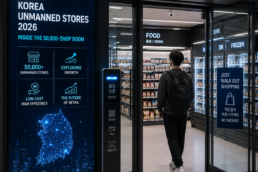


It is 8:40 on a quiet weeknight in Ilsan, a satellite city just northwest of Seoul. A man walks into an unmanned ice cream shop. There is no clerk to greet him, because there is no clerk at all. Within seconds, he grabs a shopping basket and hurls it across the room. Then he sweeps snacks and candy off the shelves, scatters them across the floor, throws whatever else he can reach, and walks out. The entire rampage lasts about one minute. He had no grudge against the owner, whom he had never met. Still, he left behind roughly 500,000 won, around $370, in damage.
Scenes like this have become an unwelcome feature of daily life across South Korea. To outsiders, the country’s staffless shops can feel almost magical. You walk in at 3 a.m., scan a tub of ice cream, tap a card, and leave, all without speaking to a single person. However, behind that frictionless convenience sits a problem that few foreign visitors ever see. Korea unmanned store crime has exploded into a genuine retail epidemic, and it is quietly reshaping a multibillion-dollar security industry in the process.
This is a story about what happens when a society automates faster than its rules, its insurance, and its social habits can adapt. Moreover, it is a story with a clear winner emerging from the chaos. As theft and vandalism overwhelm small-business owners, a new generation of AI-powered security companies has stepped in to fill the gap. For foreign investors and anyone curious about how modern Korea really works, the staffless shop at midnight is a revealing window. It shows both the promise and the peril of an automated economy.
How Big Is the Unmanned Store Theft Problem?
The headline numbers are stark. According to National Police Agency data, thefts at staffless shops climbed from 3,514 cases in 2021 to 6,018 in 2022. That marks a jump of roughly 1.7 times in a single year. By 2025, the annual figure had pushed past 10,000. In other words, reported theft at these stores has roughly tripled in four years, even as owners scramble to protect themselves.
Complaints tell a similar story. Data from the Anti-Corruption and Civil Rights Commission shows that monthly grievances tied to theft and damage at unmanned shops nearly doubled in just two years. The monthly average rose from 54 cases in 2022 to 103 in 2024. Meanwhile, the concentration in certain regions is striking. In Gyeonggi Province alone, the dense ring of cities surrounding Seoul, authorities logged 5,972 theft incidents at staffless stores across 2023 and 2024 combined.
Furthermore, the profile of the typical offender complicates any easy solution. An analysis by the S-1 Crime Prevention Research Institute found that 46 percent of unmanned store thieves are teenagers. In addition, 67 percent of all such crimes are concentrated in late-night hours, precisely when no staff and few passersby are around. The result is a perfect storm. Easy targets meet young offenders who may not grasp the consequences, all under a legal system still calibrated for an older, staffed retail world.
To understand why this matters, it helps to recall just how pervasive these shops have become. Seoulz has mapped the full scale of the staffless retail boom, which now spans more than 50,000 outlets nationwide. Each new ice cream freezer, claw-machine arcade, and self-service laundromat adds another lightly guarded node to the network. Consequently, the surface area for self-service store crime keeps expanding faster than anyone can secure it.
Why Korea’s Staffless Shops Became Easy Targets
At first glance, South Korea seems like the worst possible place for a retail crime wave. The country enjoys a relatively low overall crime rate and dense, walkable urban centers. It also has near-universal CCTV coverage and one of the world’s most advanced cashless-payment systems. So why have staffless shops become such magnets for unmanned store theft?
The answer begins with a structural vulnerability. By design, an unmanned store has no entry restrictions, so anyone can walk in at any hour. In addition, the interiors are usually fully visible from the street. That lets a would-be thief scout the layout, the cameras, and the cash machines before ever stepping inside. In this sense, the format almost engineers its own unmanned store theft problem. The open, exposed layout of these shops makes them unusually easy targets for crime, according to Lee Su-jung, a professor of criminal psychology at Kyonggi University. Without real-name authentication at the door, she argues, the format almost invites opportunistic theft. The technology gap makes things worse. A survey by the Korea Consumer Agency examined 30 unmanned stores across the Seoul metropolitan area and the Chungcheong region. Remarkably, every single one relied solely on CCTV. Not one had any form of door-entry security. That detail matters enormously, because conventional CCTV is a fundamentally passive tool. It records what happened, but it cannot stop a crime in progress. By the time an owner reviews the footage the next morning, the offender is long gone.
There is also an economic logic at work, and it connects directly to why these shops exist in the first place. The same forces Seoulz examined in its coverage of Korea’s shrinking, aging workforce and solo-household economy pushed thousands of solo founders toward staffless formats. Yet the very thing that makes the model attractive, the absence of any employee, is also what makes it defenseless. A staffed convenience store has a clerk who can intervene, call police, or simply deter trouble by being present. A staffless shop has none of that. Therefore, the cost savings on wages quietly reappear as losses from theft.
The Owners Caught in the Middle
Behind every statistic is a small-business owner absorbing the damage, and their stories reveal why the problem feels so intractable. Consider the operator in Gyeonggi Province who had installed eight CCTV cameras, a serious investment for a tiny shop. Even so, the cameras could not prevent a coordinated theft by a trio of teenagers. The suspects were caught within a week, which sounds like a victory. However, out of roughly 2 million won in damages, the owner recovered just 34,000 won, less than two percent. Defeated, the owner eventually shut the business down.
This is the cruel mechanics of compensation in the unmanned-store era. Catching the culprit rarely makes the owner whole. For one thing, many offenders are minors with no assets and limited legal liability. For another, the legal threshold for proving criminal intent can be frustratingly high. One Seoul shop owner described customers who only pretended to scan barcodes before walking out with goods. The owner then learned that proving deliberate theft was difficult, and that the matter might require civil litigation. As the owner asked, who sues over a few thousand won?
The damage is not always quiet, either. In one Gyeonggi case, two students split roles at an unmanned claw-machine arcade. They pried open a bill-exchange machine and fled with 2 million won in cash and stuffed toys. Including 3 million won in repair costs for the wrecked machine, the total loss topped 5 million won, about $3,700. According to police accounts, the pair hugged and exchanged high-fives the moment the machine door gave way. For an owner running the arcade as a low-margin side business, a single night like that can erase months of profit.
These episodes also point to a broader social strain. Petty crime in general has been climbing during Korea’s prolonged economic slowdown, and the spread of staffless shops has given that trend a convenient outlet. Reports of dine-and-dash and fare evasion, for instance, hit an all-time high of 136,835 cases in a single recent year. In short, the unmanned-store crime wave is not an isolated quirk. Rather, it is one visible symptom of deeper economic and social pressures bearing down on Korea’s self-employed.
How the Automated Store Security Industry Cashed In
Every crisis creates an opportunity, and this one has handed a fast-growing market to Korea’s security firms. As owners realized that passive cameras could not protect them, demand shifted decisively toward real-time, AI-driven prevention. This pivot is where the investment story begins, and the leading name in it is impossible to miss.
S-1 Corporation, listed on the KOSPI under ticker 012750, is the country’s dominant physical-security player and part of the broader Samsung universe. Founded in 1977, the company carries a market capitalization of roughly 3 trillion won. It provides everything from alarm monitoring to access control, as its corporate profile makes clear. For decades, its core business looked fairly conventional. Now, however, the unmanned-store boom has handed it a brand-new growth engine.
The numbers reflect that shift. S-1 reported that contracts for its AI-based security solutions tailored to unmanned stores rose 33 percent year-on-year. As one company official explained, customers increasingly recognize that simple recording-type CCTV cannot effectively counter staffless-store crime. As a result, existing clients are rapidly switching to AI CCTV-based systems. In a related vertical, jewelry stores, surging gold prices drove new security contracts up 68 percent. Meanwhile, existing customers upgrading to AI solutions jumped a remarkable 180 percent. The pattern is consistent: as crime rises and methods grow more sophisticated, demand for proactive security accelerates.
The compensation angle is just as important for owners doing the math. Alongside its monitoring, S-1 bundles a “Special Compensation Service” that covers theft or damage losses. Payouts reach up to 10 million won for a typical unmanned shop. For higher-risk businesses like jewelry stores, the coverage climbs to 300 million won. For a small operator, that guarantee can be the deciding factor. After all, it converts an unpredictable, business-ending risk into a manageable monthly cost. In effect, the security firm has begun to function as a hybrid of guard, surveillance system, and insurer all at once.
Inside the Automated Store Security Tech Stack
What exactly are owners buying when they upgrade? The shift from passive to proactive security rests on a surprisingly sophisticated technology stack. Understanding it clarifies why the automated store security market scales so well.
At the center sits AI-powered CCTV. Unlike a traditional camera that merely records, these systems analyze the live video feed to flag abnormal behavior as it unfolds. S-1’s solution, for example, can selectively detect 17 distinct types of incidents, from intrusions and fires to a disruptive, intoxicated customer who refuses to leave. When the AI spots something suspicious, the alert does not simply sit on a hard drive. Instead, it routes to a human controller at a central command center, who reviews the footage within seconds and decides whether to act.
That command layer is the second crucial piece. At S-1’s integrated control center in Suwon, large screens display real-time patrol-vehicle locations overlaid on maps of Seoul. The facility processes an average of 2.5 million security signals each month. The company says its AI now filters roughly 78 percent of incoming alerts. As a result, human controllers focus only on the cases that genuinely warrant attention. Once a controller confirms a threat, the response options escalate quickly. The response options include a remote warning broadcast through in-store speakers and an instant alert to the owner’s smartphone. If needed, a security officer is dispatched to the scene.
The hardware extends beyond cameras, too. Ultra-wideband, or UWB, sensors detect intruders during late-night hours, while specialized monitors watch cash-storage units and even flag power outages. In one real case, a UWB sensor caught two teenagers trying to break open a coin-exchange machine with a screwdriver. The system triggered an alarm and dispatched an officer. As a result, the suspects were handed to police. As Seo Jung-bae, who heads S-1’s product planning, framed it, the industry has moved away from passive video security. In the old model, you simply reviewed footage after the fact. Now, by contrast, the AI detects anomalies first and controllers respond in real time. In effect, the entire approach to Korea unmanned store crime has flipped from reactive to preventive. This same AI-everywhere logic runs through Korea’s broader tech economy. Seoulz has traced the theme in its work on the country’s homegrown AI startups and its massive AI data-center build-out.
The Investor and Founder Lens on Unmanned Store Theft
For investors weighing where the real value sits, the unmanned-store crime wave splits into two very different opportunities, and the contrast is instructive.
The first is operating the stores themselves. This path is accessible, needs only modest capital, and suits a solo founder. However, it is also crowded, increasingly saturated, and, as this article has shown, dangerously exposed to theft. The economics that worked for the first ice cream shop on a block tend to collapse by the tenth. Worse, a single bad month of vandalism can wipe out thin margins entirely. As a bet, in short, store operation offers little durable advantage.
The second opportunity is supplying the security layer, and it is far more compelling. The kiosk, payment, and surveillance vendors sit upstream of every shop. Their addressable market therefore grows with the format as a whole, not with any single storefront. Notably, the demand drivers are unusually durable. Crime is rising, and offenders are growing more sophisticated. On top of that, a regulatory upgrade cycle is now mandated. Korea began enforcing barrier-free kiosk rules in 2026, which will eventually force tens of thousands of machines to be replaced. For a foreign investor, this layer is also the more legible play. After all, it resembles a familiar recurring-revenue model of hardware plus monitoring subscriptions, rather than the quirky economics of a neighborhood claw-machine room.
There is an export angle as well, and it may prove the most interesting of all. Korea is, in effect, a live laboratory for staffless retail, complete with the security headaches that come with it. As a result, the AI-security playbook being refined here could travel widely. Its core elements, real-time anomaly detection, central monitoring, and bundled compensation, suit any market that automates its retail footprint. Japan, Southeast Asia, and beyond are all aging and automating along similar lines. Whoever masters proactive security in Korea’s demanding environment will hold a credible head start abroad.
What Self-Service Store Crime Means for Visitors and New Residents
For foreigners living in or visiting Korea, the practical takeaway is reassuring rather than alarming. The crime wave is real, but it overwhelmingly targets shop owners, not customers. In other words, Korea unmanned store crime is a business risk far more than a personal-safety one. As a user, you will still find these stores enormously convenient. You can grab a late-night snack, do your laundry, or print photos at any hour. The process is almost always the same: browse, scan, tap to pay, and go. In addition, most kiosks offer an English-language option, and many accept foreign cards.
The one thing worth understanding is the etiquette and the watchfulness. Because owners are acutely aware of theft, expect prominent CCTV signage, occasional warning broadcasts, and increasingly, AI systems that flag unusual behavior in real time. None of this should trouble an honest customer. Still, it explains why a staffless shop in 2026 may feel a little more monitored than the carefree ones of a few years ago. The cameras are watching more closely now, and for good reason.
More broadly, reading these storefronts is a small but genuine way to understand modern Korea. The vandalized ice cream shop and the AI command center are two halves of the same phenomenon. Together, they capture a society racing to automate, then racing again to secure what it automated. Those same twin pressures, efficiency first and protection second, are reshaping everything from elder care to commerce. Seoulz has followed parallel threads in its reporting on the convenience-store empire and the demographic squeeze driving the silver economy. In the end, that one-minute rampage in Ilsan is more than a viral clip. It is a preview of the challenges every automating economy will eventually face, and Korea, as so often, is meeting them first.



Related Posts