

On a weekday afternoon in 2023, shoppers at Trader Joe’s stores across America did something nobody at the chain expected. They cleared out the entire national supply of Korea frozen food — specifically, seaweed rice rolls called kimbap — in a matter of weeks. Stores slapped a two-per-customer limit on the freezer cases. A single TikTok review of the product pulled in more than eleven million views, and by October the shortage had gone nationwide. The rolls had been made by a tiny Korean startup most American shoppers had never heard of.
That sellout was not a fluke. Instead, it was a signal. For years, the world has talked about K-pop, K-drama, and K-beauty as the engines of Korea’s cultural export machine. However, a far less glamorous business hums underneath all of it: industrial freezing. The frozen K-food industry has become one of Asia’s most compelling manufacturing stories. Yet almost nobody outside the trade press is watching it closely. As a result, foreign investors and food executives are only now beginning to grasp how large the Korea frozen food opportunity has grown.
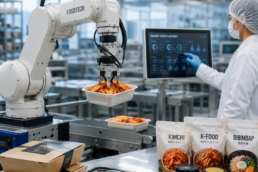
This article is not about which Korean dish tastes best abroad. Rather, it is about the factories, the production lines, and the cold-chain logistics behind the boom. It is about the localized recipes that turn a Seoul street snack into a product sitting in a Costco freezer in Ohio. In short, it is the story of how Korea built a frozen empire.
Why “Frozen” Is the Real Story
To understand the boom, you first have to understand why freezing matters so much. Fresh food does not travel well. It spoils, it fails customs inspections, and it cannot wait on a shelf for a slow-moving shopper. Frozen food, by contrast, behaves like a manufactured good. It ships in containers, stores for months, and arrives identical to how it left the plant. Therefore, freezing is what converts a perishable cultural product into something that can cross oceans and sit in mainstream retail.
The numbers make the point clearly. According to South Korea’s Ministry of Food and Drug Safety, the country’s food exports reached $7.86 billion in 2025. That figure was up 8.3 percent from the previous year. Within that total, frozen and convenience categories did the heavy lifting. As The Korea Times reported, frozen gimbap alone recorded $776 million in exports, with growth of 180.9 percent year-on-year. Meanwhile, instant ramen led all categories at $1.5 billion. For a fuller breakdown of those headline figures, Seoulz has already mapped the broader K-food global market in detail.
The deeper point, however, is structural. Frozen formats let Korean companies treat food the way Samsung treats semiconductors. In other words, the product becomes an exportable manufactured good with global distribution. Consequently, the conversation shifts away from taste. Instead, it moves toward something far more interesting for investors: factories, capacity, and supply chains. This is where the Korea frozen food story stops being about cuisine and starts being about industry.
The Mandu Machine
No company illustrates this better than CJ CheilJedang, the food arm of the CJ Group. Its flagship frozen product is Bibigo mandu — mandu being the Korean word for dumpling. It became the first single Korean food item to cross 1 trillion won, roughly $903 million, in annual sales. For perspective on scale, the company’s main dumpling plant in Incheon produces over four million dumplings daily while retaining its homemade-style texture.
What makes the achievement remarkable is where those sales come from. In North America, Bibigo mandu did something Korean food was never supposed to do: it beat the dominant local incumbent. CJ’s Bibigo Mandu reached the top in dumpling sales at Costco in the United States. In doing so, it beat China’s Ling Ling — a brand that had monopolized the US dumpling market for roughly 25 years. In addition, recent company filings show the mandu lead is not narrow. The product maintained a dominant position, outselling the second-largest dumpling brand by more than threefold.
The financial backdrop underscores how central overseas frozen food has become to the company. In 2025, a milestone arrived. As The Korea Herald reported, CJ CheilJedang’s overseas food sales reached nearly 6 trillion won, or about $4.1 billion. That total overtook domestic revenue for the first time. Furthermore, overseas food accounted for 5.92 trillion won of the food unit’s 11.52 trillion won in annual revenue. In other words, the company now sells more food abroad than at home — a reversal that would have seemed impossible a decade ago.
Going Local to Go Global
A frozen dumpling sounds like a simple thing to export. In practice, however, the winning move was the opposite of simple. CJ rebuilt the product for each market rather than shipping a single recipe everywhere. The localization is granular and deliberate.
Consider the recipe changes. In Korea, Bibigo mandu typically contains garlic chives and pork. For the American market, by contrast, CJ uses coriander instead of garlic chives. The company also developed a chicken mandu based on US food preferences. Notably, it made a branding choice that doubled as a cultural statement. While Chinese companies use the English word “dumplings,” CJ’s Bibigo insists on the Korean word “mandu,” simply spelled out in English. As a result, the product carries its Korean identity onto the shelf. It refuses to disappear into a generic category.
This “build local” philosophy extends to manufacturing itself, and it defines the modern Korean frozen food exports model. CJ pioneered a country-to-country production approach, in which a plant in one nation manufactures for export to others. For instance, its Vietnam facility produces for multiple international markets rather than serving Vietnam alone. The strategy works because freezing makes geography flexible. You can put the plant wherever land, labor, and logistics line up best.
The Factory Map
The clearest evidence of Korea’s frozen ambition is the map of where its factories now sit. CJ CheilJedang operates roughly 20 production sites globally. The recent additions tell the story of a company building for decades, not quarters.
Take the United States first. There, the company is constructing a new North American Asian Food Plant in Sioux Falls, South Dakota, targeting completion in 2027. It is set to be CJ’s largest Asian-food manufacturing plant in North America. Europe is next on the map. According to the CJ Group Newsroom, the company secured land near Budapest, Hungary, with Bibigo mandu production set to begin in the second half of 2026. That site will serve as a hub for the European market. Japan rounds out the picture. There, the company recently inaugurated a new mandu plant in Kisarazu City, Chiba Prefecture. Built on a 42,000-square-meter site, it represents an investment of roughly $73 million. That Chiba plant, importantly, marks CJ’s first direct manufacturing investment in Japan. It adds to four dumpling factories the company already acquired there in 2019.
The European push has already paid off. For the first time since entering the region in the late 2010s, CJ CheilJedang’s annual sales in Europe surpassed 100 billion won. To support this global build-out, the company leaned heavily on acquisitions. Most significant was its 2019 purchase of the American frozen-food firm Schwan’s, which handed CJ instant scale and shelf access across US grocery. For readers tracking how Korean conglomerates expand abroad through deals like this, the same playbook of consolidation appears in Seoulz’s coverage of the Korean Air–Asiana merger.
The Kimbap Surprise
If mandu is the blue-chip story, frozen kimbap is the startup shock. The category barely existed as an export product five years ago. Today, it is one of the fastest-growing segments in Korean food.
The breakout moment came in August 2023. A small Korean startup called Allgot placed 250 tons of frozen kimbap on the shelves of Trader Joe’s in the United States. Within days, the product sold out nationwide. The viral wave that followed was extraordinary. A video of Korean-American food creator Sarah Ahn eating frozen gimbap with her mother garnered eleven million views in just three weeks. Certain Trader Joe’s branches limited purchases to one per customer. NBC ran a story on the sellout. Consequently, demand outstripped supply for months.
Allgot, however, was not the original pioneer. That distinction belongs to Bokmansa, a company based in rural Hadong County. According to KED Global, Bokmansa started shipping frozen kimbap abroad in 2020, first to Hong Kong. It now exports to 19 countries including the US, the UK, Qatar, and Indonesia. After its US success, Allgot moved fast to scale. The company planned to ramp production capacity tenfold, targeting 300,000 rolls per day. It also pursued entry into Costco in San Francisco and Los Angeles.
The startups also discovered an unexpected truth: foreign shoppers understood that kimbap was not sushi. “When I go to foreign exhibitions, I see many people already aware that gimbap is different from sushi,” Allgot’s CEO noted, crediting the Korean Wave for the familiarity. That cultural distinction matters commercially. Specifically, it lets kimbap occupy its own retail identity rather than competing in the crowded sushi case. This kind of screen-to-shelf pathway — where a drama or viral clip drives real purchases — mirrors the marketing dynamics Seoulz examined in its look at the Korea mukbang industry.
The Cold Chain Backbone
None of this works without an unglamorous piece of infrastructure: the cold chain. Frozen food can only conquer foreign shelves if it stays frozen from the plant in Korea to the freezer case abroad. Any break in that temperature-controlled journey ruins the product.
Korea has built that backbone aggressively. The country’s cold-chain and frozen-food logistics market is now valued at around $15 billion. Perishable-goods demand, e-commerce grocery growth, and food-safety regulations all drive it. Refrigerated transport, blast freezing, and temperature-controlled warehousing form the invisible spine of the entire export boom. Furthermore, the same logistics muscle that powers Korea’s famously fast domestic delivery translates directly into export competence. Seoulz has explored how that delivery-and-logistics culture reshapes Korean retail in its analysis of Korea live commerce.
Crucially, the cold chain is also where the picks-and-shovels investment opportunity lives. Brands capture headlines. However, logistics operators capture margin on every box that moves. For investors wary of betting on which dumpling brand wins, the infrastructure layer offers exposure to the whole Korea frozen food category at once.
Beyond Dumplings and Kimbap
The frozen empire is widening well past its two signature products. Several adjacent categories are now scaling along the same factory-and-cold-chain template.
Korean corn dogs are a vivid example. The cheesy, sometimes potato-coated street snack has found a global audience. The export figures reflect it. Exports of Korean-style corn dogs reached $45.3 million, up 99.5 percent year-on-year. Pulmuone, one of the category leaders, exported more than ten million frozen corn dogs to the US and Japan in a single year. Frozen tteokbokki — chewy rice cakes in spicy sauce — is following the same path. Today, Bibigo and Pulmuone kits sit across major US grocery chains.
Even the giants are still expanding their frozen portfolios. CJ’s frozen gimbap, launched globally in early 2023, saw cumulative sales top six million units by mid-2025. Meanwhile, the overseas momentum shows up in the company’s regional growth. In Japan, Q2 sales rose 37 percent year-over-year, driven by mandu and a dedicated Bibigo retail presence. The pattern repeats across product after product. Take a beloved Korean food, freeze it, localize it, and ship it through the cold chain into mainstream retail.
The Investor Angle
For foreign investors, the frozen-food boom presents a layered opportunity rather than a single bet. Each layer carries a different risk profile.
The blue-chip exposure is CJ CheilJedang, listed on the Korea Exchange. It owns the most globally diversified frozen-food portfolio of any Korean company, anchored by Bibigo and backed by Schwan’s in the US. However, its earnings also reflect broader pressures. In 2025, overall operating profit fell 15.2 percent to 861 billion won amid soft domestic demand and rising input costs. That happened even as overseas food hit records. For investors, the takeaway is clear. Overseas frozen food is the growth engine, while the domestic and bio segments drag.
The mid-cap and surprise-mover tier is equally interesting. When seafood major Sajo Daerim announced its move into frozen kimbap, the market reacted instantly. Sajo Daerim stock skyrocketed by a daily limit of 30 percent. Sister companies Sajo Seafood and Sajo Industries also both soared 30 percent. That single trading session captured how investors view frozen K-food. They treat it as a category hot enough to re-rate an entire corporate family. For the venture-minded, the startup tier — Allgot, Bokmansa, and a wave of imitators — offers earlier-stage exposure through Korean foodtech accelerators, though these names are largely private.
Risks and What Comes Next
No honest analysis ignores the risks, and the frozen empire faces several real ones. First, success breeds imitation and fraud. Korean authorities have warned that counterfeit K-food products are undermining authentic global growth. Such fakes dilute brand value abroad. Second, trade friction is a live threat. Korean frozen gimbap has already faced US tariff exposure, and any escalation could squeeze margins overnight. Third, individual product crazes can cool. US frozen-gimbap import figures actually dipped from their 2024 peak before settling at a higher baseline. That pattern is a reminder that viral spikes are not permanent demand.
Yet the structural case remains strong. Korea is no longer simply selling food abroad. Instead, it is building factories, owning cold-chain infrastructure, and localizing recipes market by market. That is the behavior of a durable manufacturing industry, not a passing food fad. Industry voices increasingly frame the goal in exactly those terms. They want to move beyond one-off exports toward products that local consumers seek out in their daily lives. For broader context on how far this Korea frozen food export engine has already traveled, Seoulz’s deep dive on K-food exports traces the full decade-long arc.
The next chapter will be written in concrete and steel — in the South Dakota plant opening in 2027, the Hungarian hub coming online in 2026, and the cold-chain networks knitting them together. Korea turned a street snack into a container-shipped commodity. Now it is turning that commodity into a global manufacturing footprint.