

In 2014, a team of linguists ran a simple test. They played recordings of everyday sentences to Korean speakers from Seoul, Busan, and Yeosu. The listeners scored below 10 percent. Then the researchers played the same recordings for older residents of one southern island, who scored above 89 percent. The language was Jejueo, and it comes from a place that sits on Korean maps, uses Korean money, and votes in Korean elections. Yet Jeju island culture has never quite been Korean culture, and the reasons are not mystical. They are geological, fiscal, and violent.
Most visitors arrive on Jeju expecting a resort. Roughly 13.9 million of them came in 2025, and the marketing calls the place “the Hawaii of Korea.” However, that framing hides something stranger. Jeju spent most of recorded history as a separate kingdom, then a Mongol horse ranch, then a prison the Korean state sealed shut for two centuries. What grew inside that seal was a society with different gods, a different language, a different economy, and a radically different arrangement between men and women.
This article follows one chain of cause and effect. It begins with rock that cannot hold water, and it ends with the only province in South Korea where more than 70 percent of adults work.
It Starts With Rock: Why Jeju Island Culture Has No Rice
Rice defines mainland Korean life. Paddies shaped the calendar, the tax system, the village hierarchy, and the food. Jeju, meanwhile, could not grow it.
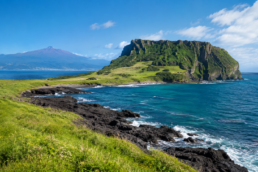
The island is basalt, built by eruptions that also produced the lava tubes behind its UNESCO World Heritage listing. Basalt soil is porous, so water drains straight through it. As a result, flooded paddies were impossible across most of the island. Farmers grew millet, barley, buckwheat, beans, and sweet potatoes instead. They also grew tangerines, which the mainland court demanded as tribute as early as the 5th century.
Wind made the problem worse. Typhoons hit Jeju first, and topsoil blows off open ground. So islanders built walls. They stacked the volcanic stones they pulled from their own fields into low, deliberately gappy barriers that let wind pass through instead of knocking them down.
These field walls are called batdam, and their combined length runs to roughly 22,000 kilometers. That is more than half the circumference of the Earth, built by hand, one rock at a time. In 2014, the FAO recognized the batdam system as a Globally Important Agricultural Heritage System.
Still, walls do not feed anyone. Jeju farming produced subsistence and tribute, rarely surplus. Consequently, the sea was not a supplement to the island economy. The sea was the economy, and that single fact reorganized everything else, including who held power inside a Jeju household.
When the Men Died at Sea, the Women Went Under
Diving for shellfish and seaweed around Jeju goes back roughly a thousand years, and both sexes did it at first. Men were called pojak; women were called jamnyeo. Then the balance flipped, and three forces pushed it.
First came death. Seventeenth-century warfare and deep-sea fishing accidents killed Jeju men in large numbers, which left diving work to whoever remained. Second came taxes. Eighteenth-century records show dried abalone levied as tribute on ordinary households, and the burden fell so hard that pregnant women were sent into cold water to meet the quota. Third came physiology. Women carry more subcutaneous fat and shiver at lower temperatures, so they tolerate long immersion better than men do.
What emerged was the haenyeo, the sea women, whose practice UNESCO inscribed on its Intangible Cultural Heritage list in 2016. No other element of Jeju island culture is so widely photographed and so badly misunderstood. They dive without tanks to about 10 meters, hold roughly a minute per dive, and surface with a whistling exhale called sumbisori. During peak season they work up to seven hours a day.
Their bodies adapted, too. In 2025, researchers publishing in Cell Reports compared haenyeo with non-diving Jeju women and mainland women, and they found genetic variants linked to cold tolerance and blood pressure regulation. CNN covered the study alongside a striking measurement: a haenyeo’s heart rate drops far more sharply on a dive than an untrained diver’s does.
Romantic coverage tends to stop there. Nevertheless, the more interesting consequence is economic, because women who earn change the rules of a household.
The Economics That Confucianism Could Not Reach
Joseon Korea ran on Neo-Confucian order, and that order assumed a male provider. Women stayed inside, inherited little, and appeared in the ritual record mainly as wives and mothers. On Jeju, that model collided with the balance sheet.
By the early 1960s, haenyeo harvests accounted for around 60 percent of Jeju’s fisheries revenue. At the same time, roughly 40 percent of their husbands had no work at all. In some villages, diving income supplied 40 to 48 percent of total household earnings. Meanwhile, colonial-era reforms had ended the old tribute system, which meant divers finally sold their catch at market and kept the money.
Cash changes standing. Because the wife’s income was visible and continuous, Jeju households negotiated differently from mainland ones. Here sits the hinge of the whole culture of Jeju: patriarchy arrived, but it never held the purse. The stereotype of the loud, decisive Jeju grandmother is not folklore. It is what happens when the person holding the household’s cash flow is also the person going to work.
The divers organized, too. Fishing cooperatives called eochongye set their own rules, and they still do: no harvesting conch under 7 centimeters or abalone under 10, plus agreed limits on diving days. Harvested seaweed was pooled and split into standard sacks, distributed evenly regardless of who gathered more. Furthermore, when villages needed something, the divers funded it. Between 1951 and 1958, several communities rebuilt burned-down elementary schools with seaweed money, on plots the women still call “school sea.”
Then in 1932, they went further. Over roughly a year, 10,713 divers staged 238 collective actions against Japanese colonial price-fixing. It remains the largest women-led resistance movement of the colonial period, and its leaders went to prison for it.
An Island of 18,000 Gods: Jeju Culture at the Shrine
Jeju’s tourism authority describes the island as home to 18,000 gods, and somewhere between 200 and 400 village shrines still stand. Every settlement had its bonhyangdang, the shrine of the local guardian deity. Others handled specific worries: children’s health, or safety at sea.
Mainland shamanism works differently. There, a mudang is usually called by a spirit illness, then enters trance so the god can speak through her. On Jeju, by contrast, the practitioner is a simbang, who stays conscious and mediates through inherited brass implements called menggu. The role passes down family lines rather than arriving as a summons. Crucially, the simbang is a neighbor, not an outsider, so ritual sits inside the community instead of on its margins.
The mythology diverges as well. Mainland Korea tells of Bari, the abandoned princess. Jeju tells of Seolmundae Halmang, a giantess so large that she lay on Hallasan with her feet in the sea, and whose spilled apronfuls of earth became the island’s 360 volcanic cones. In other words, the creator here is a grandmother.
The most visible ritual survives on the calendar. Yeongdeunggut, inscribed by UNESCO in 2009, welcomes the wind goddess Yeongdeung in the second lunar month, then sends her off fifteen days later on a small straw boat. Haenyeo and boat owners lead it, which is precisely the point.
So why did this survive when the mainland’s shamanic economy went underground? Partly geography, since Joseon’s bans on “licentious rites” were hard to enforce across a strait. Partly money, because divers paid for the rituals. And partly need, given that a woman going 10 meters down without air treats a safety ritual as infrastructure rather than superstition.
A Century as a Mongol Horse Ranch
Before Joseon locked the island down, another empire had already reshaped it. In April 1273, Goryeo and Mongol forces stormed the fortress at Hangpaduri, crushing the last holdouts of the Sambyeolcho rebellion. Jeju then passed into Mongol hands for roughly a hundred years.
The Yuan dynasty saw grazing land, not scenery. Around 1276, the Mongols established a state ranch and shipped in 160 horses. At its height, the island supplied about 20,000 animals. Jeju effectively became a cavalry factory for the largest land empire in history, and mainland Korea had little say in the matter.
Getting it back required a war. When Goryeo demanded horses for the new Ming court in 1374, the Mongol herdsmen stationed on Jeju refused and revolted. The court dispatched 314 ships and 25,605 soldiers under General Choe Yeong to retake a piece of its own territory. Few Korean provinces have ever required an invasion force that size.
The linguistic residue is thinner than legend suggests, since scholars find only faint Mongol traces in Jeju speech, mostly horse vocabulary. Nonetheless, the ranching stuck. Horses remain a real industry here, worth about 185 billion won in 2025, and the native Jeju horse has been a protected natural monument since 1986.
Two Hundred Years of Lockdown
In 1629, the Joseon court did something remarkable. Tribute demands had grown so heavy that islanders were fleeing to the mainland, which raised the burden on everyone left behind. Rather than lower the quotas, the government banned departure outright.
The chullyuk geumjiryeong, or exit prohibition, held for roughly two centuries until the 1820s. Enforcement went beyond paperwork, since authorities also restricted boatbuilding so that islanders could not simply sail away. Fishermen worked from rafts as a result, and drowning rates climbed, which produced still more widows on an island already short of men. The Jeju National Museum describes the era plainly as two centuries of prohibition.
One episode captures the scale of it. Kim Man-deok, a merchant born in 1739, spent her fortune feeding roughly 18,000 people during the famines of the 1790s. King Jeongjo offered her any reward she wished. She asked to see Seoul and Mount Geumgang — a request that required a royal exemption, because Jeju women were forbidden to leave.
Meanwhile, traffic ran the other direction. Joseon used Jeju as its terminal exile, and between 200 and 300 people were banished there over five centuries. Deposed King Gwanghaegun died on the island in 1641. The calligrapher Kim Jeong-hui spent eight years there from 1840, and during that confinement he perfected the chusa script and painted Sehando in 1844, now among the most celebrated works in Korean art.
Exile therefore became the island’s library. Scholars arrived with books and left with students, and the museum credits them with opening islanders’ eyes to the outside world. Consequently, the culture of Jeju absorbed just enough of the mainland to stay legible, while retaining almost everything that made it different.
What Isolation Did to the Food
Cut an island off for two hundred years and its kitchen drifts. Jeju food still tastes like the constraints that produced it, which is why so little of it appears on mainland menus.
Start with what was missing. Seasonings arrived by boat, so pepper, salted fish sauce, and imported spice stayed scarce and expensive. Jeju kimchi therefore turned out milder and simpler than the mainland version, and locals often call it jimchi rather than kimchi. Households also skipped the great autumn kimchi-making marathon, because cabbage and radish kept growing through the mild winters. Why store a year’s supply when the field is a pantry?
Pigs filled the protein gap that rice-fed livestock could not. Jeju’s black pigs were traditionally raised in dottongsi, stone pens built beneath the outhouse, a practice that persisted into the 1960s. Foreign readers usually wince at this detail. Islanders, meanwhile, point out that it closed a nutrient loop on land too poor to waste anything.
Village feasts then produced their own cuisine. When a household slaughtered a pig for a wedding or funeral, nobody discarded the broth. Cooks added mom, a local gulfweed, plus offal and buckwheat flour, and the result is momguk, a soup you essentially cannot order outside Jeju. The same broth yields gogi-guksu, the island’s pork noodle bowl.
Citrus, finally, became the cash crop that rebuilt the postwar island. A French missionary named Émile Taquet introduced 15 satsuma mandarin trees in 1911. By the 1960s, a single mature tree could cover a child’s university tuition, which earned the plant its nickname: the college tree.
A Language Frozen in the Fifteenth Century
Nothing shows the cost of isolation more clearly than the way islanders speak. Two centuries of enforced quarantine preserved Jeju traditions of speech the way amber preserves insects. Jejueo kept the vowel arae-a, a sound Seoul Korean lost during the 18th century, along with medieval grammar and vocabulary that vanished from the standard language.
The result is not a dialect in any practical sense. Recall that 2014 comprehension test, where mainland listeners scored under 10 percent while island natives cleared 89. Linguists increasingly treat Jejueo as a separate language, and the University of Hawai’i Press published the first English-language academic grammar of it in 2019.
UNESCO classified Jejueo as critically endangered in December 2010, placing it a single step from extinct. Estimates once put fluent speakers at 5,000 to 10,000, nearly all elderly. Today scholars quoted by The Korea Times suggest the number of truly fluent speakers falls well under 1,000. A 2010 survey drove the point home: of 120 everyday Jejueo words, only 11 were recognized by more than 70 percent of respondents.
Language policy is now catching up, if late. The province’s fourth Jejueo development plan runs from 2023 to 2027 with a budget near 16 billion won, covering a comprehensive dictionary, a web dictionary, a planned museum, and a bid for UNESCO intangible heritage status.
Yet the sharpest decline had a specific cause, and it was not television or schooling. It was the killing.
1948: The Year the State Erased a Tenth of the Island
One event marks Jeju island culture more deeply than any dynasty did. The uprising began on April 3, 1948, and the suppression ran until 1954. Official investigators have confirmed 14,373 victims, while historians estimate the true toll approached 30,000 — roughly a tenth of the island’s population at the time.
The physical damage was near total in the interior. Around 70 percent of Jeju’s villages burned, more than 39,000 homes were destroyed, and approximately 40,000 people fled to Japan, mostly Osaka, or north. Whole communities never returned to their old sites.
Then came the silence, which lasted about half a century. Under successive anti-communist governments, describing how your family died could get you interrogated, jailed, or worse. Since mourning in public was dangerous, families mourned where the state was not watching. Shamanic ritual became the safe channel, so the gut absorbed a function that funerals could not perform. In that sense, the massacre did not weaken Jeju’s old religion. It reinforced it.
Repair came slowly. The National Assembly passed a special law in 2000, and President Roh Moo-hyun issued a formal state apology in 2003. The police and defense ministry followed in 2019. A 2021 amendment set compensation at 90 million won per victim, the largest state reparations program for any historical incident in South Korea. As of the latest tally, roughly 724 billion won has been paid to 9,344 recognized victims.
In April 2025, the archives of the incident entered UNESCO’s Memory of the World Register — 14,673 items documenting what nobody was allowed to say for fifty years. Meanwhile, in May 2026, Korea’s Constitutional Court upheld a provision letting posthumously adopted heirs claim criminal compensation, which matters because 41 percent of the dead were in their twenties and left no direct descendants.
What Jeju Island Culture Looks Like in 2026
Every thread above is still moving, and the numbers tell you which way.
Start with the divers. Jeju counted 23,081 haenyeo in 1965 and 14,143 in 1970. By the end of 2025, the registry listed 2,371 — a decline of about 83 percent. More than 63 percent are over 70, while fewer than 4.4 percent are under 50. Entry costs money as well as nerve, since joining a fishing cooperative typically requires one to three million won plus a share contribution. On current trends, the count drops below 2,000 within a year or two. The province budgeted 23.5 billion won for haenyeo support in 2026, including a monthly stipend for new entrants aged 40 to 44.
The island’s population tells a parallel story. After 14 straight years of net in-migration, Jeju flipped to net outflow in 2023. That outflow reached 4,273 people in 2025, and Koreans in their twenties made up 53.8 percent of it. The romantic “move to Jeju” wave that peaked in the 2010s has reversed.
Agriculture is shifting too. In 2025, fisheries revenue hit 1.58 trillion won and overtook tangerines for the first time. Furthermore, warming has pushed growers toward tropical fruit, with mango and banana acreage up 77.8 percent while citrus land contracts.
Tourism, by contrast, is rebounding unevenly. Domestic visitors fell for a third consecutive year to about 11.6 million, whereas foreign arrivals jumped 17.7 percent to 2.24 million, of whom roughly 70 percent came from China. Korea’s broader inbound tourism boom is reaching the island mainly through non-Korean travelers.
One television series accelerated that. Netflix’s When Life Gives You Tangerines premiered in March 2025, and afterward Taiwanese arrivals rose 63 percent while mentions of haenyeo experiences exploded online. The Haenyeo Museum reported foreign visitors up 58.9 percent, according to The Korea Herald. Notably, the drama’s dialogue is in Jejueo, so Korean viewers needed subtitles for a show set inside their own country.
Jeju is betting on this attention. The province has proposed halving the income threshold for Korea’s digital nomad visa for island-based applicants and extending stays from 30 to 90 days.
Reading the Island: Jeju Traditions You Can Still See
Once you know the chain of causes, the landscape starts explaining itself.
Those black walls threading between fields are batdam, and their gaps are engineering rather than sloppiness. The squat basalt figures at village entrances are dol hareubang, “stone grandfathers,” first recorded in 1754; 47 or 48 pre-modern originals survive.
Look for three wooden poles resting in stone posts at older gates. That is a jeongnang, and it is a message system: all three poles up means the owner has gone far, one pole means back soon, and all three down means somebody is home. Consider what that implies. Jeju households publicly advertised when their homes stood empty, which only works in a place whose proverb boasted of three absences — no thieves, no beggars, no gates.
For the rest, go to the specific sites. The Haenyeo Museum in Hado sits near working diving grounds. Jeju 4·3 Peace Park handles the massacre directly and without euphemism. Samseonghyeol marks the three holes where, in the founding myth, the island’s first men emerged and later married three princesses who arrived by sea with grain and livestock — a creation story in which women bring civilization. Meanwhile, the National Museum of Jeju covers Tamna, the independent kingdom that traded with Baekje, Silla, Tang China, and Japan before Goryeo absorbed it in 1105.
Jeju is not a Korean province with unusual weather. It is a place that spent most of its history somewhere else, and whose people were shaped by rock that would not hold water, a court that would not let them leave, and a state that came for them in 1948. Understanding that changes what you see. Consequently, the island reads less like a beach destination and more like a country with its own folk traditions, its own dead, and 2,371 women who still go under.