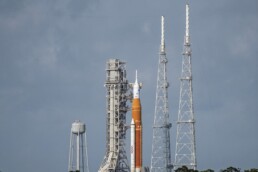


A satellite the size of a shoebox is changing the economics of space. In November 2023, a SpaceX Falcon 9 rocket carried a small Korean micro-satellite into orbit. That single successful deployment quietly set off a chain reaction—one that is now reshaping South Korea’s commercial space industry and attracting attention from NASA itself.
From ₩16.3 Billion to ₩132.4 Billion in Two Years
NaraSpace, founded in 2015, targets ₩132.4 billion (approximately USD 97 million) in revenue for 2025. That figure represents roughly an eightfold increase from the ₩16.3 billion the company recorded in 2023. Meanwhile, 2024 revenue is forecast to reach ₩43 billion—a number that itself would have seemed ambitious just two years ago.
The driver is straightforward: space heritage. In the satellite industry, space heritage refers to a proven track record of successfully launching and operating hardware in orbit. Without it, even technically sound companies struggle to win contracts. With it, orders flow. NaraSpace’s Observer 1A satellite delivered exactly that credential.
Space heritage is not a marketing term—it is a procurement filter. Government agencies and defense contractors routinely reject vendors who lack it, regardless of price.
Observer 1A: The Satellite That Unlocked the Business
Observer 1A is a 16U CubeSat—roughly 20 × 20 × 30 centimeters—with more than 60% of its components domestically sourced. That localization figure matters in the context of South Korea’s broader industrial policy, which has long pushed to reduce dependence on foreign components in strategic sectors.
NaraSpace CEO Park Jae-pil described the moment of signal acquisition in blunt terms: “The first development took three years. Additional units can now be produced in a week.“ In other words, the hard engineering problem is solved. What remains is scaling production and winning contracts—a far more tractable challenge.
For investors, the one-week production cycle is the number that matters most. It implies margins that improve sharply with volume.
NASA, Nuri, and a Growing Client List
Since securing space heritage, NaraSpace has accumulated contracts that span both the upstream and downstream segments of the satellite value chain. The company provides end-to-end solutions: satellite design and manufacturing on one side, imagery sales and AI-powered data analytics on the other.
In particular, two projects stand out. First, NaraSpace is developing the K-RadCube, a cubesat selected to participate in NASA’s Artemis program—the United States’ flagship lunar exploration initiative. Second, the company is building the EEETester satellite, which will ride aboard South Korea’s domestically developed Nuri rocket (누리호) on its 4th through 6th launches. EEETester is designed to evaluate the reliability of Korean-made electronic components—including semiconductors from Samsung Electronics—under actual space conditions.
Additional clients include Hanwha Systems, one of South Korea’s largest defense and aerospace conglomerates, and the Korea Aerospace Research Institute (KARI), the government body that oversees the Nuri rocket program. That client roster signals credibility across both the public and private sectors.
Furthermore, NaraSpace has developed proprietary AI-based super-resolution (SR) technology that enhances low-resolution satellite imagery to near-high-resolution quality. This capability transforms raw data into a monetizable product—and gives the company a differentiated offering in the downstream market.
Korea’s New Space Moment
NaraSpace’s trajectory reflects a broader structural shift. South Korea is moving from a state-led space program toward a commercial ecosystem—what Korean industry observers call the New Space era. Historically, Korean space development was dominated by government research institutes and large conglomerates (재벌, chaebol). However, a new generation of startups is now competing directly for government contracts that were once reserved for those incumbents.
Yuanta Securities noted that demand for low-cost, high-efficiency micro-satellites is rising sharply, and that NaraSpace has established a “virtuous cycle” between satellite manufacturing and imagery sales. As a result, the company is positioned to benefit from both the hardware boom and the growing market for space-derived data.
NaraSpace raised ₩20 billion in a Series B round in 2024, bringing cumulative investment to ₩33.5 billion. The company is now targeting a KOSDAQ listing on December 17, 2025, under South Korea’s technology special listing pathway—a regulatory mechanism that allows pre-profit tech companies to go public based on technology evaluation rather than earnings history.
What Comes After the IPO
Post-listing capital will fund two priorities. First, NaraSpace plans to deploy a constellation of more than 100 satellites within five years, enabling near-real-time monitoring of major cities worldwide. Second, the company intends to accelerate entry into Thailand, Mexico, and Middle Eastern markets—regions with growing demand for satellite imagery and limited domestic supply.
The constellation ambition is where the business model scales—or doesn’t. Building 100 satellites is a manufacturing and logistics challenge as much as an engineering one. Nevertheless, the one-week production cycle, if it holds at scale, makes the target plausible in a way it would not have been for earlier generations of satellite companies.
A shoebox-sized satellite changed NaraSpace’s fortunes. A constellation of them could change the company’s category entirely.