South Korea Signs U.S.-Led San Francisco Declaration on AI and Supply-Chain Security
The non-binding pact covers sensitive technologies and critical infrastructure, while Seoul's nuclear submarine bills advance in the National Defense Committee.
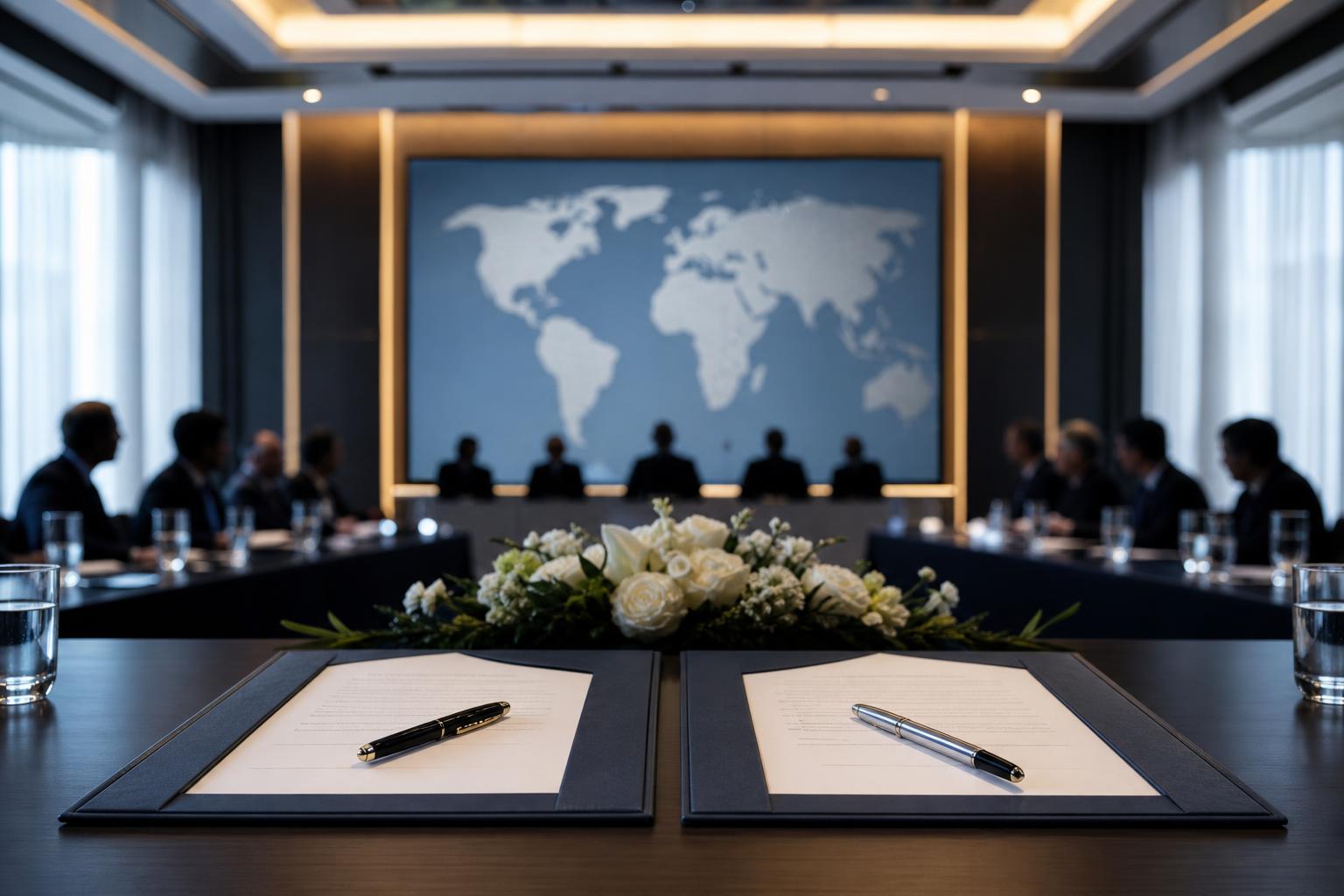
South Korea signed the U.S.-led San Francisco Declaration on Nov. 15, joining nine other governments in a framework for securing supply chains for artificial intelligence and other sensitive technologies, according to the U.S. Department of State.
Vice Foreign Minister Kim Jina attended the Pax Silica Founders Retreat in San Francisco and signed the declaration, Edaily reported on Nov. 16. The retreat was convened by Under Secretary of State for Economic Affairs Jacob Helberg.
The State Department identified the releasing governments as the United States, Australia, India, Israel, Japan, Republic of Korea, Qatar, Singapore, United Arab Emirates and United Kingdom.
The declaration affirms that economic security is fundamental to national security and sets out a common understanding of sensitive technologies and critical infrastructure underpinning Super Intelligence supply chains, the State Department said. A footnote noted that for some participants, "super intelligence" refers to "artificial intelligence."
Sensitive technologies are defined to include goods, software, materials, knowledge, components and inputs used to produce them, and their means of production essential to SI supply chains, where theft or illicit transfer could confer a meaningful military or intelligence advantage or undue economic leverage, according to the State Department.
Critical infrastructure includes ports, terminals, transport, communications and logistics networks, ICT and energy infrastructure, and digital platforms that coordinate and manage them, the State Department said.
The declaration resolves to establish five proposed working groups covering pro-innovation policy frameworks, SI adoption in key sectors, supply-chain cooperation across the SI stack, safe harbors and supply-chain security hubs, and SI security and resilience, according to the State Department.
Edaily reported that the declaration is a non-binding political agreement and does not finalize new export controls or joint regulatory measures.
Nuclear Submarine Bills Advance
Separately, South Korea's National Defense Committee placed on its agenda two special bills for nuclear-powered submarines on Nov. 16, Edaily reported. The government bill is titled "Special Act on the Acquisition, Operation and Safety Management of Nuclear-Powered Submarines," and Rep. Yoo Yong-won's bill is the "Special Act on the Nuclear-Powered Submarine Project."
Both bills were sent to the bill review subcommittee after a senior professional committee member's review report, without a separate substitute debate, according to Edaily.
The review agreed with the purpose of a special law but emphasized separating project execution from safety management, Edaily reported. The government bill gives the defense minister authority over installation, operation, dismantlement approval and safety regulation of nuclear-powered submarine reactors, while Yoo's bill assigns major approval authority to the Nuclear Safety and Security Commission.
The review warned that the government bill could become self-regulation because the defense minister would be both the subject of obligations and the target of regulation, according to Edaily.
The Defense Ministry said its nuclear-powered submarine policy planning group's "Defense Nuclear Safety Division" would handle related work, while it is reviewing expansion into a proposed "Defense Nuclear Safety Bureau," Edaily reported.
Neither bill explicitly defines a land-based prototype test facility for a submarine reactor, even though the review described such a facility as a preceding project needed to verify performance and safety and train crews, according to Edaily.
The government is pursuing a mid-2030s launch of the first boat and service entry in the late 2030s or later, Edaily reported. The 2027 government budget proposal includes $72.4 million (96.6 billion won) for the project, while total project cost has not yet been confirmed.