

Korea used to buy American weapons. Now it is selling them back.
LIG D&A, the defense arm of South Korea’s LIG Group, has formally incorporated LIG Defense U.S. Inc. — a dedicated American subsidiary — marking one of the most direct bids yet by a Korean arms maker to crack the world’s largest defense market. The move is more than a corporate filing. It signals a structural shift in how Seoul’s defense industry sees itself: not as a regional supplier, but as a global competitor.
In addition, the timing is deliberate. Washington is under pressure to stretch its defense procurement budget, and allies are looking for capable, affordable alternatives to American-made systems. LIG Defense US steps into that gap.
From Importer to Exporter: The K-Defense Arc
For decades, South Korea was one of the United States’ most reliable arms customers. However, the relationship has quietly reversed. By 2023, Korea had reached $14 billion in annual defense exports, entering the global top-ten arms exporters — a ranking once dominated exclusively by NATO members and Russia.
Korea’s defense build-up traces back to the 1970s, when President Park Chung-hee launched a self-reliance program after Nixon signaled a partial U.S. troop withdrawal. The result, decades later, is a domestic industry capable of producing precision-guided munitions, air-defense systems, and autonomous robotics — largely without foreign licenses.
LIG D&A (the company is in the process of rebranding from LIG Nexone) sits near the top of that ecosystem. Its backlog stands at approximately 26.2 trillion won — roughly six years’ worth of contracted work — a figure that gives the company the financial stability to invest aggressively overseas.
The defense industry is capital-intensive and relationship-driven. A U.S. subsidiary is, therefore, not just a sales office — it is a lobbying asset, a contracting vehicle, and a trust signal to Pentagon procurement officers.
The Products Behind the Push
LIG D&A’s flagship export items are well-known in defense circles. The Cheongung-II (M-SAM2) is a medium-range surface-to-air missile system priced at roughly half the cost of a Patriot interceptor — which runs around $4 million per missile. Hana Securities analyst Chae Un-saem notes that with U.S. Patriot annual production capped at around 600 missiles, Middle Eastern buyers are turning to Cheongung-II as a practical complement rather than a compromise.
Affordability, in this market, is a strategic weapon.
Meanwhile, the Bigung — a 2.75-inch precision-guided rocket — has cleared a threshold that no Korean weapon had crossed before. It passed the U.S. Department of Defense’s Foreign Comparative Testing (FCT) program, an evaluation process designed to identify non-American systems worth integrating into U.S. military procurement. FCT approval does not guarantee a contract, but it is the essential first step. LIG Defense US is now positioned to translate that technical endorsement into an actual deal with the U.S. Navy.
The Hyungung, a man-portable anti-tank guided missile, rounds out the export portfolio. Together, these systems cover air defense, naval strike, and ground combat — a breadth that few mid-tier defense companies can match.
Ghost Robotics and the Autonomous Warfare Play
Missiles are only part of the story. In a move that drew attention well beyond Korea’s defense community, LIG acquired a 60% stake in Ghost Robotics — the Philadelphia-based maker of quadruped military robots — for $240 million, valuing the company at $400 million.
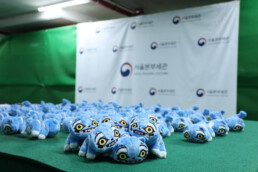
Ghost Robotics’ dog-like machines have already been tested by the U.S. Air Force and Special Operations Command. By owning the majority stake, LIG gains direct access to Pentagon relationships, U.S. defense contracts, and the engineering talent needed to build next-generation unmanned systems.
Furthermore, the acquisition creates a platform for autonomous surface vessels (USVs) and ground robots — areas where defense budgets are growing fast as militaries seek to reduce human casualties in contested environments. The synergy between LIG’s existing weapons systems and Ghost Robotics’ autonomous mobility is not incidental. It is the blueprint for a next-generation, unmanned-capable defense contractor.
For investors, this is the key variable: Ghost Robotics gives LIG a foothold in the U.S. defense-tech ecosystem that would otherwise take a decade to build organically.
The Network Strategy: A Four-Star Hire
Hardware alone does not open Pentagon doors. Relationships do.
LIG Defense US has appointed Vice Admiral Rich Brown (ret.) — former commander of U.S. Pacific Fleet Surface Forces — as its senior advisor. Brown’s network spans the U.S. Navy’s acquisition chain, the Office of the Secretary of Defense, and the Indo-Pacific combatant commands that would be the primary users of systems like Bigung.
Brown himself has framed the appointment in terms of American defense needs: “At a time when the U.S. needs to scale battle-tested, cost-effective weapon systems, the establishment of LIG Defense US is very timely. Partnering with an experienced partner like LIG is a rational choice for U.S. defense procurement.”
Hiring retired flag officers as advisors is a standard — and legally scrutinized — practice in Washington defense contracting. Nevertheless, the choice of a Pacific Fleet commander signals that LIG’s primary U.S. target is naval and Indo-Pacific-focused, aligning with Bigung’s naval application and the broader strategic competition with China.
LIG Defense US and the Bigger Alliance Shift
The establishment of LIG Defense US is part of a broader evolution in the U.S.-Korea defense relationship. The alliance, historically structured around U.S. weapons sales to Korea and American troop presence on the peninsula, is now developing a third layer: co-development, co-production, and co-marketing of weapons systems.
Korean officials describe this as “3rd-generation defense industrial cooperation.” In practice, it means Korean firms are no longer just licensed manufacturers or subcontractors — they are originating technology and bringing it to American buyers.
As a result, the geopolitical logic reinforces the commercial one. Washington wants allies to carry more of the defense burden; Seoul wants its defense industry to generate export revenue and sustain its industrial base. LIG Defense US sits at the intersection of both interests.
The next visible milestone will likely be the Sea-Air-Space Exposition — the U.S. Navy’s premier industry event — where LIG Defense US is expected to make its formal American debut. A Bigung supply contract with the U.S. Navy would validate the entire U.S. strategy. A joint venture with a major American prime contractor would take it further still.
Korea spent fifty years building a defense industry to protect itself. It is now spending the next fifty selling that industry to the world — starting with its oldest ally.